
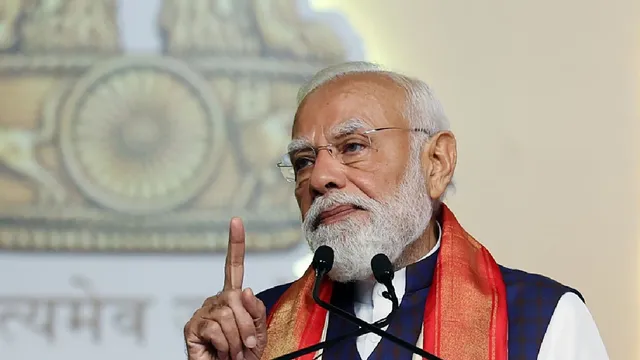
Prime Minister Narendra Modi's call for self-austerity and economic self-reliance amid global uncertainty is seen as a major move to protect India from the heat of the ongoing conflict in West Asia. His appeal to avoid non-essential gold purchases in order to save foreign exchange reserves is termed a rational strategy by industry experts in the given circumstances. The move could help conserve valuable foreign exchange at a time when the country is facing rising import pressures due to global uncertainties.
PM Modi, while addressing a rally organised by the Telangana BJP in Hyderabad on Sunday, suggested reducing petrol and diesel consumption, using metro rail services in cities, carpooling, increasing the use of electric vehicles (EVs), utilising railway services for parcel movement and working from home to conserve foreign exchange amid the crisis in West Asia.
ALSO READ: ‘Avoid Buying Gold, Use Less Fuel, Attend Online Classes’: PM Modi Doubles Down On Retraint Appeal
What Has PM Modi Said?
Quantifying India's import dependency through crude oil analysis while identifying energy security as an acute vulnerability, PM Modi noted that global supply chain disruptions were created by regional conflict. "The country desperately needs the power of public participation, as a very large portion of India's imports constitutes crude oil sourced from regions today embroiled in conflict, creating dual crises of scarcity and price escalation," asserted PM Modi.
Recommended For You
PM Modi's Push For WFH, Usage Of Public Transport
Prescribing collective action through small individual pledges while detailing petrol-diesel reduction strategies, the Prime Minister advocated for public transport prioritisation alongside car-pooling initiatives. Extending conservation appeals to workplace digitalisation through virtual meeting prioritisation and work-from-home arrangements, he identified technology-enabled solutions as force multipliers. "Wherever possible, reduce consumption of petrol and diesel by using metro, electric buses, and public transport more; both government and private offices must prioritise virtual meetings and work-from-home arrangements to significantly reduce unnecessary fuel consumption," urged the PM.
Expanding foreign currency conservation imperatives to culinary and precious metal domains while addressing leisure consumption patterns, the Prime Minister appealed for reduced cooking oil consumption with health co-benefits alongside postponement of gold purchases during crisis periods. Observing escalating foreign currency outflows through international vacation trends and destination wedding fashionability, he quantified the impact across multiple sectors.
PM Modi’s appeal for restraint is a preemptive strategy to protect the country from a worldwide hard austerity pattern, which has already hit several nations. These nations have already gone beyond appeals and have mandates like fuel rationing, compulsory work-from-home, fuel caps, lower speed limits, and travel curbs to tackle the 2026 oil crisis.
Global Phenomenon
In response to global energy crises, the IEA Tracker documents emergency energy conservation measures taken by approximately 40 countries (plus the European Commission). These countries curbed fuel and mobility. Even advanced economies resorted to imposing excise duty cuts, state aid frameworks, warnings against gouging, and sector-specific relief for transport, farming, and high-mileage users. At least three nations implemented hard austerity policies by rationing, half-filling cylinders, or shifting to electric/PNG alternatives. 18 countries adopted mobility reduction strategies like fuel rationing/caps, alternate driving days, promotion of public transport/carpooling, limits on private/government vehicles, and EV incentives. 13 countries promoted Work-From-Home (WFH).
Many countries (Pakistan, Indonesia, Sri Lanka, South Korea, Malaysia and others) encouraged or mandated remote work for civil servants and promoted it in the private sector to cut commuting.
AC Cooling Limits
Authorities in several countries adopted measures to reduce power consumption. They set temperature setpoints for ACs in offices and public buildings. Bangladesh (25°C), Singapore (25°C, prioritise fans), Cambodia (24–25°C), Malaysia (24°C) and Sri Lanka (26°C) adopted austerity measures to save energy.
Government Travel Restrictions
Some countries like Pakistan, Jordan, Egypt, Malaysia, South Korea and others, implemented restrictions on the usage of personal vehicles or limited air/road travel and international trips.
Schools and Universities
The heat of the fuel austerity has also been felt by students in several countries. They had to adapt to online classes and a shortened number of physical classes. Pakistan closed all physical classes.
Public Campaigns And Mandates
A few countries have been hit so hard by the energy crisis that they have had to ask businesses and offices to save energy by using lighting and other electronic devices less. Thailand asked office workers to limit demand (including taking stairs, turning off devices) and local authorities to reduce rural street lighting. The United Kingdom increased the grant for households to switch from LPG- or oil-based heating to heat pumps and other home retrofit measures.
Transport And Fuel Measures
Korea imposed odd-even no-driving days. Sri Lankans are asked to use QR code rationing. Likewise, several nations went to rationing, odd-even rules, speed limits and promoting public transport/EVs.
Notable Broader Actions
Nations like France, the UK, Chile, Cambodia, Lao PDR, Myanmar and Thailand made a big push for efficiency and electrification by pressing solar installations, LED retrofits, heat pump grants (e.g., UK, Netherlands, Spain), and EV adoption.
Emergency Declarations
Some nations declared a national energy emergency to deal with the global fuel shortage. Madagascar declared an emergency for 15 days, the Marshall Islands for 90 days, and Tuvalu for 2 weeks on one island; the Philippines and Sri Lanka for until the next order.
Targeted Restrictions
Nepal, Maldives, Pakistan, Egypt and Sri Lanka imposed targeted restrictions for LPG cylinders, market closures and billboard lighting off.