
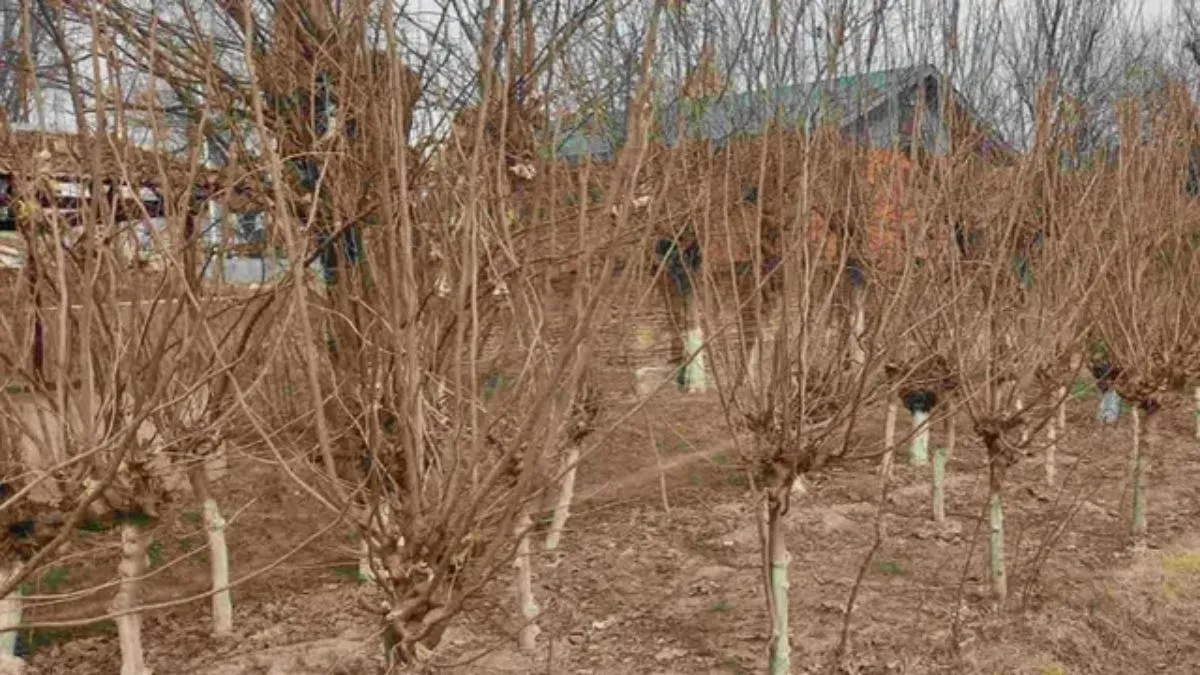
The Jammu and Kashmir state government has identified the site of a nearly 200-year-old mulberry nursery in Allochibagh, Srinagar, to develop a new residential colony for senior administrative officers and legislators.
The Sericulture Department and farmers associated with silkworm rearing have objected to this decision. They stated that this move is not only a major blow to the silk industry in Jammu and Kashmir but will also result in the destruction of a historical heritage.
The history of silk production in Kashmir is quite ancient. However, it was the Dogra rulers who promoted silk production on the lines of an industry, establishing the nursery in Allochibagh, Srinagar, around 1890. This cottage industry still supports the livelihoods of approximately 50,000 silkworm rearing farmers. These are farmers registered with the Sericulture Department for training, technical assistance, and other facilities.
200 Flats To Be Built For Dignitaries
Concerned officials stated that the government plans to abolish the Sericulture Department’s nursery, which is spread over 12 kanals in Allochibagh, to construct 200 flats for senior administrative officers and dignitaries. Currently, about 15,000 mulberry saplings are grown here annually for distribution to silkworm rearers in the valley. A Sericulture Department officer explained that nutrient-rich mulberry leaves are the only source of fodder for silkworms.
Recommended For You
This nursery contains not only mulberry plants but also leaf banks created by the department to assist landless silkworm rearers. Silkworm rearer Ghulam Mohammad said, "Mulberry trees are very important to us. My livelihood and my family's sustenance depend on sericulture. If a single mulberry tree is cut, our livelihood suffers. I do not understand what this government wants or why the mulberry nursery is being destroyed."
5.5 Million Mulberry Trees On 2,000 Acres
There are approximately 5.5 million mulberry trees in Jammu and Kashmir, cultivated on 2,000 acres of land. These trees are maintained across more than 320 units, including government farms, nurseries, and plantations. Under its specific Holistic Agriculture Development Programme (HADP), the government has also launched a campaign to plant an additional 1 million mulberry saplings in the state.
According to the Sericulture Department, cocoon production has consistently increased over the past three years. In 2024-25, cocoon production reached 8.5 lakh kilograms, up from 8.22 lakh kilograms in 2023-24 and 6.99 lakh kilograms in 2022-23. Raw silk production has also risen, increasing from 1 lakh kilograms in 2022-23 to 1.21 lakh kilograms in 2024-25.
Environmentalist Rasikh Rasool stated that no individual can cut a mulberry tree without permission, and there are strict rules even for shedding its leaves or pruning it. The Jammu and Kashmir Preservation of Specified Trees Act, 1969, also guarantees the protection of mulberry trees. "However, here an entire nursery is being destroyed. If the government wants to develop a residential colony, it can choose another location," he said.
Sericulture Department Refuses To Transfer Land
An official from the Sericulture Department mentioned that several new facilities related to the silk industry have been added to the Allochibagh nursery over the past year. Keeping in mind the vital role of these trees, the investment made in Allochibagh, and the existing infrastructure, the land cannot be relinquished.
He revealed that the plan to abolish the Allochibagh nursery to build residences for MLAs, ministers, and officers was first conceived in April 2018 during the PDP-BJP coalition government. Now, the National Conference government has initiated work to fast-track this proposal, but the Sericulture Department has refused to transfer the land.
He stated that the Assistant Commissioner (Revenue) of Srinagar constituted a team on January 6 to demarcate the Allochibagh nursery and initiate the process of making the land available for construction activities. However, on January 9, the Director of Sericulture opposed this, asserting that the land is crucial.
ALSO READ: Bihar Mines Department To Install ANPR System At Border Check Posts To Curb Illegal Sand Mining
Nursery Vital For Kashmir Silk Industry
In addition to the necessary infrastructure and operational facilities for sericulture, the site houses administrative buildings. These include the Sericulture Training Institute, Central Division Srinagar, a modern grainage building, a cocoon warehouse, a cocoon auction market, modern hot air dryers, the mulberry farm and nursery, and a 2-metric-ton conveyor-type hot air dryer.
Referring to an order dated April 20, 2018, Sericulture Director Ajaz Ahmad Bhat stated that the department had refused to hand over the land at that time as well, citing the basic and technical facilities associated with sericulture, its environmental importance, and economic issues.
"We have informed the administration that we cannot spare this land for any activity other than silkworm rearing. There are hundreds of well-grown mulberry trees on this land, which are the main and only source of fodder for rearing silkworms. It would be best for the silk industry if the status quo of that silk-producing land remains unchanged. Alternative land can be identified for the proposed construction," he said.