
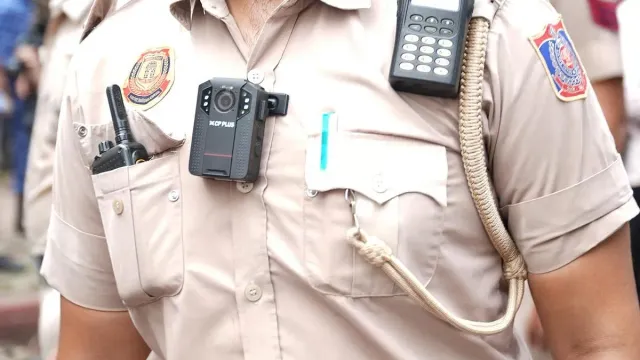
- Delhi HC directs government to consider body cameras for police.
- PIL sought mandatory use by Delhi Police and RAF personnel.
- Government given six months to frame SOP for camera use.
Following allegations of violence during protests, the Delhi High Court on Wednesday asked the government to treat a public interest litigation (PIL) seeking mandatory use of body-worn cameras by Delhi Police and Rapid Action Force (RAF) personnel as a representation.
A bench of Acting Chief Justice Nitin Wasudeo Sambre and Justice Arun Bhardwaj asked the government to decide within six months whether to frame a standard operating procedure (SOP) for the use of body-worn cameras during protests and crowd-control operations.
The court said the issue concerned policing in general and not just the Delhi Police.
“Why should we direct them to legislate? It cannot be said that it is a grey area,” the bench observed while hearing the plea.
The court also questioned the need for judicial intervention when laws already exist to regulate police procedures.
“We are not concerned about Delhi Police only, but we are concerned with entire policing,” the bench said.
Who filed the PIL?
The PIL was filed by Chahat Raghav, who has sought mandatory use of body-worn cameras by Delhi Police and RAF personnel during protests and crowd-control situations.
The plea also seeks rules for the storage, retention and use of footage recorded by the cameras.
Senior Advocate Akhil Sibal, appearing for the petitioner, said body-worn cameras could improve transparency and accountability during protests, especially when there are allegations of police excesses and counter-allegations against protesters.
Sibal said police were already using body-worn cameras in some situations, but not regularly. He also pointed out that the Delhi Police’s 2022 standing order on rallies and demonstrations does not specifically provide for their use.
"If technology is available, it can go a long way in fixing accountability whenever required. It is different from facial recognition where there are concerns of surveillance," the senior counsel argued.
The petitioner also referred to the use of body-worn cameras by traffic police and a tender for procuring such cameras, saying the technology was already available to the authorities.
Court questions need for judicial intervention
The court questioned whether the issue should be dealt with by the executive or legislature instead of through a court order.
Additional Solicitor General Chetan Sharma, appearing for the respondents, said the Delhi High Court’s PIL rules require a petitioner to first approach the concerned authorities through a representation. He suggested that the present PIL could be treated as such a representation.
Sharma also said the Supreme Court had directed authorities to frame an SOP while dealing with protests at Jantar Mantar. He added that the existing system already provides for videography of protests.
However, Sibal said regular videography was different from body-worn cameras used by police personnel directly involved in crowd control.
The court then recorded the ASG’s statement and directed the respondents to decide within six months whether to frame an SOP on the use of body-worn cameras.
The petitioner was given liberty to approach the High Court again if the authorities failed to act.
( With agency inputs )