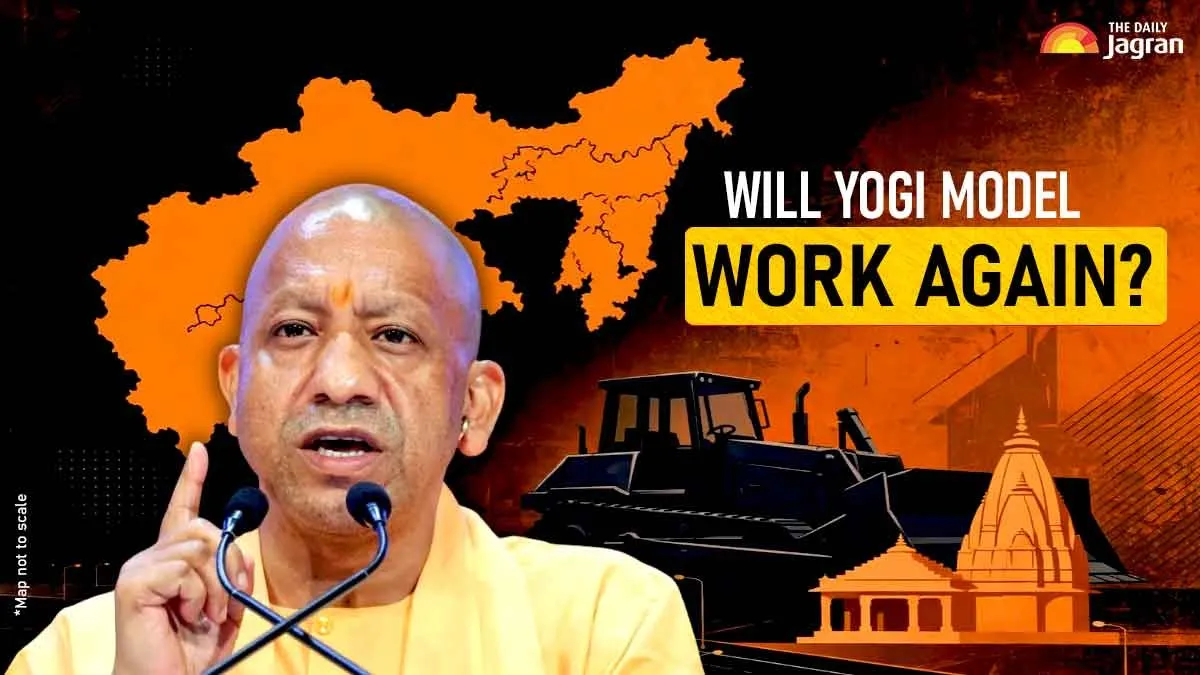
- Yogi Model focuses on law, infrastructure, Hindutva, welfare, economy.
- Bulldozer action became a key symbol of tough governance in UP.
- BJP to leverage model's success for 2027 Uttar Pradesh elections.
Uttar Pradesh Elections 2027: With the 2027 Uttar Pradesh Assembly elections approaching, political parties have begun preparing for a crucial electoral battle in the country's most populous state. While opposition parties are gearing up to challenge the ruling BJP, Chief Minister Yogi Adityanath is eyeing a third consecutive term.
Since coming to power in 2017, the BJP has built its political narrative around what is popularly known as the 'Yogi Model'. The model has been central to Yogi Adityanath's style of governance and the party's political messaging in the state.
But what exactly is the Yogi Model? What are its key features, and how could the BJP use them to seek another term in the 2027 Uttar Pradesh Assembly elections? Let's take a closer look.
What Is The Yogi Model?
The Yogi Model refers to the governance approach followed by Chief Minister Yogi Adityanath since he took office in 2017. It focuses on five major areas: law and order, infrastructure development, Hindutva, welfare delivery and economic growth.
Recommended For You
The BJP presents the model as an approach that has changed Uttar Pradesh's image through stricter action against crime, better connectivity, investment and the delivery of government schemes.
Over the years, these issues have also become important parts of the party's political messaging.
What Are The Key Pillars Of The Yogi Model?
1. Law and Order
Law and order has been one of the biggest promises of the Yogi Adityanath government since it came to power in 2017.
The government launched a crackdown on organised crime, mafia networks and illegal land grabbing. Police encounters increased, while several high-profile gangsters were either arrested or killed.
The BJP has repeatedly presented these actions as evidence of its tough approach towards crime. The government argues that better law and order has improved people's sense of safety, particularly among traders, women and investors.
According to the National Crime Records Bureau's (NCRB) 'Crime in India 2024' report, Uttar Pradesh recorded a crime rate of 180.2 per lakh population, below the national average of 252. 3.
The state's murder rate stood at 1.3, compared with the national average of 1.9. Its crime rate against women was 58.0, also below the national average of 64.6.
Before the Yogi government came to power, NCRB data showed that Uttar Pradesh accounted for 9.5% of the total crimes reported across the country in 2016.
However, the government's claims of improved law and order have also faced questions over police encounters, the use of force and the handling of criminal cases.
2. Bulldozer Action: A Symbol Of The Yogi Model
One of the most recognisable symbols of the Yogi Model is 'bulldozer action'. The term became popular after the state government began using bulldozers to demolish properties linked to alleged illegal constructions, encroachments and properties associated with accused criminals.
The government has defended these actions as part of its campaign against organised crime, land grabbing and the mafia. Properties linked to gangsters such as Vikas Dubey, Mukhtar Ansari and Atique Ahmed were among those targeted.
Over time, the bulldozer also became a political symbol for the BJP. It has featured in party campaigns, posters and public events, representing the government's tough approach towards crime.
However, the practice has faced criticism over allegations of arbitrary demolitions and the lack of due process.
In 2024, the Supreme Court laid down guidelines to regulate demolitions, making it clear that authorities cannot demolish someone's property merely because they are accused or convicted of a crime.
3. Infrastructure and Economic Development
Infrastructure development is another major part of the Yogi Model. The government has focused on improving road connectivity, airports, metro services and industrial infrastructure.
Several expressway projects, including the Purvanchal Expressway, Bundelkhand Expressway and Ganga Expressway, have been part of this push. The Gorakhpur Link Expressway is another major project.
The state has also expanded metro services in cities such as Lucknow, Kanpur and Agra, including with the NAMO Bharat RRTS Corridor. The Noida International Airport at Jewar and the development of Ayodhya's airport are also part of the government's infrastructure plans.
Apart from connectivity, the government has promoted the Uttar Pradesh Defence Industrial Corridor to attract investment and strengthen the state's industrial sector.
In healthcare, projects such as AIIMS Gorakhpur and AIIMS Rae Bareli have also been highlighted as part of the state's development push.
The BJP has used these projects to present Uttar Pradesh as a state undergoing infrastructure and economic transformation.
4. Hindutva and Cultural Identity
Hindutva remains another important pillar of the Yogi Model.
Yogi Adityanath's identity as a Hindu religious leader and his association with the Gorakhnath Math have played an important role in shaping his political image.
His government has placed considerable emphasis on religious tourism, temple development and cultural events.
Projects such as the Kashi Vishwanath Corridor, the development of Ayodhya and the Ram Temple, along with the Ram and Krishna circuits, have featured prominently in the government's cultural agenda.
Events such as Ayodhya's Deepotsav and the annual Kanwar Yatra have also received significant attention.
The BJP has used these initiatives to connect with Hindu voters and strengthen its Hindutva-based political narrative.
The discussion around religious sites has continued beyond Ayodhya. On November 17, Deputy Chief Minister Keshav Prasad Maurya said that a temple dedicated to Lord Krishna would be built on the lines of the Ram Temple in Ayodhya.
Yogi Adityanath has also repeatedly used the slogan "Batenge toh Katenge" while appealing for Hindu unity. His political messaging has often focused on the idea that the Hindu vote should remain united.
The BJP's 80-20 formula has also featured in this political narrative, with Yogi Adityanath claiming that the BJP and its allies would secure 80 per cent of the votes and assembly seats, while the remaining 20 per cent would go to the Opposition.
5. Welfare Schemes and Direct Benefits
Welfare delivery is another important part of the Yogi Model. The government has focused on providing benefits directly to eligible families through various central and state schemes.
These include free ration, housing under the PM Awas Yojana, financial assistance to farmers and free cooking gas connections.
The government has also focused on women's welfare through schemes such as the Mukhyamantri Kanya Sumangala Yojana, which provides financial assistance to girls at different stages of their lives.
Under the double-engine government model, the BJP highlights the coordination between the Centre and the Uttar Pradesh government in implementing welfare schemes.
ALSO READ: From MPs, MLAs To Deputy CM: Five Mayawati Aides Who Are Now At The Helm In UP After Leaving BSP
The party also refers to beneficiaries of these schemes as 'Labharthis'. These include families who receive free rations, housing, financial assistance and other government benefits.
The BJP sees these beneficiaries as an important section of its voter base, as welfare schemes allow the party to connect directly with households across caste and community groups.
How Could Yogi Model Help BJP In The 2027 UP Elections?
As Uttar Pradesh heads towards the 2027 Assembly elections, the Yogi Model is likely to remain a major part of the BJP's campaign.
The party can use its record on law and order, infrastructure development, welfare schemes and religious projects to highlight its nine years in power.
Yogi Adityanath's leadership and his political identity also give the BJP a recognisable face in the state.
The Ram Temple in Ayodhya and the Mahakumbh have further strengthened the party's focus on religious and cultural issues. These developments are likely to feature in its political messaging ahead of the polls.
However, the 2027 elections will also bring fresh challenges for the ruling party.
Issues such as unemployment, paper leaks, recruitment delays, stray cattle affecting farmers and pending sugarcane payments could become important election issues.
ALSO READ: Why Bundelkhand Matters In UP Polls 2027: Inside BJP's Rise Across 19 Seats
While the Samajwadi Party, led by Akhilesh Yadav, has been focusing on its PDA (Pichhda, Dalit and Alpsankhyak) strategy, which seeks to bring together backward classes, Dalits and minorities. The party has also raised issues such as the caste census, jobs and the Constitution.
Another factor the BJP will have to deal with is anti-incumbency after nearly 10 years in power. While the government's actions against criminals and mafia networks have become a central part of its political identity, voters will also assess its performance on employment, education, agriculture and everyday concerns.
Ultimately, the Yogi Model has shaped the BJP government's identity in Uttar Pradesh since 2017. For the 2027 elections, the party is likely to rely on its governance record, welfare schemes, infrastructure projects and Hindutva agenda.