
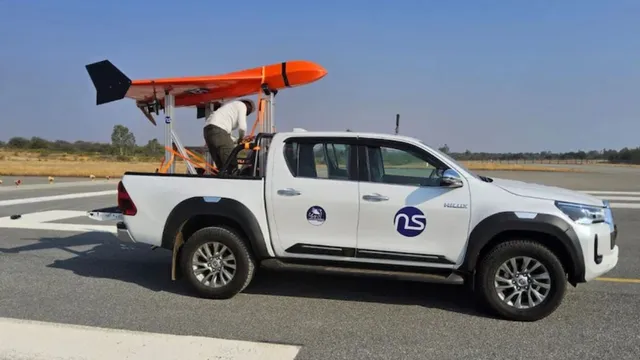
Sheshnaag-150 Drone: Amid the escalating cross-border strikes in the Iran-Israel-US conflict, one of the most talked-about weapons during this war is the suicide drone. Throughout the ongoing conflict, Iran, the US, and Israel have been increasingly using drone warfare to target one another.
On one side, Iran's 'Shahed-136', and on the other, America's 'LUCAS', have proven to be both cheaper and more deadly than traditional weapons.
As global tensions mount and the future of warfare shifts towards drone technology, India has also been preparing itself for the age of autonomous warfare. While much of the world focuses on the existing players, India has been quietly developing its own indigenous drone 'the Sheshnaag-150'.
What is Sheshnaag-150 Drone?
The Sheshnaag-150, a long-range swarming attack drone developed from the ground up by Bengaluru-based defence startup Newspace Research Technologies (NRT), made its maiden flight a year ago. Designed for coordinated swarm attacks, this drone allows multiple units to infiltrate enemy defences and deliver precise strikes.
Recommended For You
With an operational range exceeding 1,000 km and the ability to stay airborne for over five hours, the Sheshnaag-150 can loiter over a target area, providing both real-time surveillance and attack capabilities.
It is capable of autonomously identifying, tracking, and engaging enemy targets with minimal or no human involvement. It can carry warheads weighing between 25 and 40 kg, potent enough to cause significant damage to infrastructure, vehicles, or personnel.
How Sheshnaag-150 Shines Up: Iran & US vs India
The ongoing Middle Eastern conflict has given the world a front-row seat to the evolving art of drone warfare. Iran’s Shahed-136 has been particularly effective, providing a powerful lesson in asymmetric warfare. By leveraging mass saturation, the Shahed-136 has been able to overwhelm sophisticated air defences and strike high-value targets at an incredibly low cost.
While, America's LUCAS is a low-cost alternative, designed using a similar concept but with technological advancements, including integration with Starlink for secure, unhackable guidance. The LUCAS continues to demonstrate that in modern warfare, quantity, autonomy, and low cost often trump the traditional focus on expensive, high-tech weapons.
This evolving understanding of drone warfare has sparked growing interest in similar systems within India’s military ranks. The case for drones like the Sheshnaag-150 has arguably never been more urgent, with India shifting its military doctrine to incorporate more drone-centric strategies under times like 'Operation Sindoor'.
Meanwhile, it is the Sheshnaag-150's technology that sets it apart. While designing small drones may not be overly complicated, the real innovation lies in the proprietary mother-code behind the Sheshnaag system. This algorithm ensures the drones can function intelligently, communicate with each other, and autonomously decide the best attack strategy, all while continuously adapting to new circumstances.
The LUCAS may be a technological step forward from the Shahed-136, but the Sheshnaag-150 seeks to go even further. It will eventually feature a visual navigation system, enabling it to function in environments where global navigation satellite systems (GNSS) are unavailable paving the way for more resilient, versatile autonomous operations.
To sum up, while drones like the Shahed-136 and LUCAS have reshaped modern warfare, India’s Sheshnaag-150 seeks to push the boundaries even further, signalling a new era in autonomous, swarm-based drone operations.