
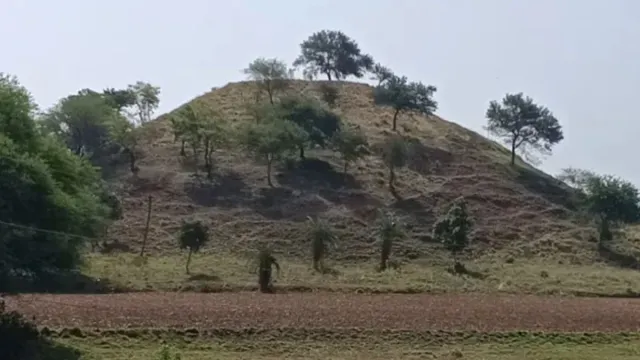
- MP, ASI plan fresh excavation at Ujjain's Vaishya Tekri mound.
- Ancient Buddhist stupa, 2,200 years old, linked to Emperor Ashoka.
- Stupa potentially larger than Sanchi, a major archaeological find.
Bhopal: The Madhya Pradesh government and the Archaeological Survey of India (ASI) are planning a fresh excavation at the Vaishya Tekri mound in Ujjain. An ancient Buddhist stupa dating back approximately 2,200 years to the Mauryan Emperor Ashoka's reign is believed to have been buried there. This massive structure is thought to be even larger than the world-famous Sanchi Stupa situated in the Raisen district of Madhya Pradesh.
Fresh Excavation Planned
A partial excavation of this massive mound was first carried out during British rule in 1938-39. However, the work was halted after labourers lost consciousness due to a toxic gas leak. Now, after nearly nine decades (90 years), Madhya Pradesh Chief Minister Mohan Yadav is making efforts to take this project forward. The MP government, in collaboration with the ASI, is preparing to conduct fresh excavations.
Huge Than The Sanchi Stupa
According to an archaeological report from the British era, the diameter of this stupa in Ujjain was recorded as 350 feet and its height as at least 100 feet. This is far greater than the Sanchi stupa, which has a diameter of 120 feet and a height of 54 feet. The report dates this structure to approximately the 3rd century BCE, the Mauryan period. In the same report, Vaishya Tekri, located about 236 kilometers west of Sanchi, has been described as a massive circular mound surrounded by a rectangular moat.
Recommended For You
Linked To Emperor Ashoka
During the partial excavation, the remains of two smaller stupas were discovered alongside the main stupa. It is considered an 'extraordinary architectural creation,' featuring a rare style. According to experts and archaeological reports, this stupa may have a direct connection to Emperor Ashoka. Although no definitive evidence has been found, Shivakant Bajpai, Superintending Archaeologist at the ASI, states that certain ancient inscriptions and historical evidence link this monument to the Mauryan ruler's reign.
Why Was It Named 'Vaishya Tekri'?
It is believed that when Ashoka was the Governor of Ujjain, he commissioned the construction of this stupa at the behest of his wife, who was the daughter of a prominent merchant (Nagar-shreshthi) from Vidisha. Consequently, the site became known as Vaishya Tekri. However, in ancient Buddhist literature, Vaishya Tekri has also been linked to the Kanakagiri Vihara and to a massive stupa described by the Chinese traveler Hiuen Tsang. Both of these associations remain unverified so far.
What Was Discovered During 1939 Excavations?
According to Bajpai, excavations in 1939 revealed that the stupa's inner core was constructed using local murrum (gravelly soil). Meanwhile, large bricks were set in mud mortar as the outer layer. As much of the outer brick layer got destroyed by rain and natural elements over the years, the stupa's original structure, layout, and exact height could not be fully determined.
Ashoka Commissioned 84,000 Stupas
According to historians, Emperor Ashoka commissioned the construction of 84,000 stupas across India in memory of his wife (Mahadevi). Vaishya Tekri, which serves as a site of deep reverence for devotees from India and countries such as China, Sri Lanka, Japan, and Cambodia, is believed to be one of such stupas. While it was granted the status 'Nationally Protected Monument,' no development work has yet taken place.