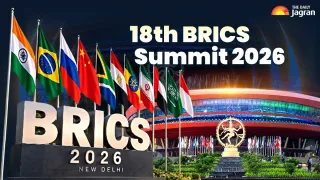
BRICS Summit 2026: On September 12 and 13, India is hosting the 18th BRICS summit, making it the fourth chairship of the grouping. As a major platform for emerging economies, the summit brings together global leaders to discuss themes such as inclusive governance, sustainable development, and financial cooperation. The theme for the international event is “Building for Resilience, Innovation, Cooperation and Sustainability.” The 11 countries include Brazil, China, Egypt, Ethiopia, India, Indonesia, Iran, Russia, Saudi Arabia, South Africa, and the UAE are part of BRICS. Collectively, these countries constitute 49.5 per cent of the global population, 26 per cent of global trade, and 40 per cent of global GDP.
Origin Of BRICS
The acronym BRIC originated in 2011 by Goldman Sachs in its Global Economics Paper, “The World Needs Better Economic BRICs.” Recognizing their shared global influence, the paper stated that Brazil, Russia, India, and China would become the world’s largest economies over the following five decades. In December 2010, the alliance transitioned into BRICS when South Africa was officially invited to join. This expanded the group’s geographic representation to the African continent.
When Was BRICS Formed?
In September 2006, when the Foreign Ministers of Brazil, Russia, India, and China held their first high-level meeting on the sidelines of the UN General Assembly, the formation of BRICS formally occurred. Furthermore, the group solidified in June 2009 at its first official heads-of-state summit in Yekaterinburg, Russia. The original format evolved into BRICS in December 2010 when South Africa was officially invited into the bloc, expanding its collaborative footprint across the Global South. Following its inclusion, South Africa attended the 3rd BRICS Summit in Sanya in 2011. In January 2024, Egypt, Ethiopia, Iran, Saudi Arabia and the UAE became full members of BRICS, while Indonesia became a full member in January 2025.
Moreover, in 2005, Belarus, Bolivia, Kazakhstan, Cuba, Malaysia, Nigeria, Thailand, Uganda, Uzbekistan, and Vietnam joined BRICS as partner countries.
Member Of BRICS
BRICS consists of 11 full members following multiple expansions. The full members hold the supreme decision-making power and have the voting rights to make policies and treaties. Here is the list of full members of BRICS:
Brazil (Founding Member)
Russia (Founding Member)
India (Founding Member)
China (Founding Member)
South Africa (Joined in 2010)
Egypt (Joined in 2024)
Ethiopia (Joined in 2024)
Iran (Joined in 2024)
Saudi Arabia (Joined in 2024)
United Arab Emirates (Joined in 2024)
Indonesia (Joined in 2025)
Official Partner Countries
Besides the full members, the alliance also has 10 recognized partner nations to facilitate other emerging countries.
Belarus
Bolivia
Cuba
Kazakhstan
Malaysia
Nigeria
Thailand
Uganda
Uzbekistan
Vietnam
Aim And Objective Of BRICS
The main objective of the formation of BRICS is to promote economic, political, and cultural cooperation among major emerging countries while promoting sustainable growth. Some of the key objectives are as follows:
1. The alliance is responsible for facilitating mutual trade, investment, and economic cooperation among member nations to accelerate domestic growth.
2. It pushes for structuring international bodies such as the IMF, the UN, and World Bank to support the Global South.
3. BRICS collaborate on counter-terrorism, cybersecurity, and regional stability through shared intelligence and diplomatic dialogue.
4. The bloc promotes trade in local currencies, thereby reducing the dependency on the US dollar.
5. To build resilient technologies, the members share digital infrastructure.
6. Without compromising economic progress, the members cooperate on climate action, green energy transitions, and food security goals.