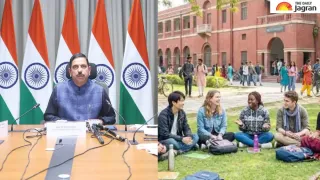
Union Minister for Education Pralhad Joshi on Wednesday chaired the first meeting of the Consultative Committee of the Parliament for the Ministry of Education for 2026. Union Minister of State for Education Jayant Chaudhary, Higher Education Secretary Deepti Gaur Mukerjee, School Education and Literacy Secretary T. K. Anil Kumar and other senior officials attended.
Addressing the meeting, Joshi said the Indian Knowledge System has a long history of global impact, and the Ministry aims to expand its global footprint further.
Foreign Campuses in India, Indian Campuses Abroad
To this end, several steps are being taken to set up campuses of Indian Higher Education Institutions (HEIs) overseas and to facilitate the setting up of foreign university campuses in India. Joshi said around 21 foreign HEIs are currently operational in the country, in addition to joint academic and research collaborations.
He added that the demand for CBSE schools abroad demonstrates the credibility of Indian education programmes and their potential for scalability globally.
Four Strategies for Internationalisation
The Department of Higher Education outlined four strategies: academic and research collaborations, attracting international students to study in India, allowing Foreign HEIs to set up branch campuses in India, and allowing Indian HEIs to set up campuses abroad.
So far, 17 Letters of Intent (LoI) have been issued to foreign universities under UGC Regulations, including those from the UK, the USA, Australia and Italy. Members were also briefed on Bharat Innovates, SPARC (Scheme for Promotion of Academic and Research Collaboration), GIAN (Global Initiative of Academic Networks), DASA (Direct Admission of Students Abroad) and the revamped Study in India (SII) portal.
268 CBSE Schools Across 26 Countries
The Department of School Education and Literacy stated that the NEP 2020 and the Viksit Bharat 2047 vision were providing guidelines for the transformation of the education system. The important factors that have led to internationalisation include curriculum in compliance with international standards, multilingual teaching, exchange programs for both students and teachers, and the PARAKH (Performance Assessment, Review, and Analysis of Knowledge for Holistic Development) National Assessment Center for equivalency and quality alignment.
At present, there are 268 CBSE schools in operation in 26 countries, while an overseas regional office has been set up in Dubai. There is a standardized testing system that has been put in place in the affiliated schools internationally. The members lauded the work done by the Ministry and gave recommendations.
(With ANI Inputs)