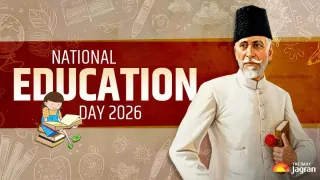
Maulana Azad Education Vision: National Education Day is celebrated every year on November 11th across India in honor of the birthday of Maulana Abul Kalam Azad, who was India’s first education minister. He was in office from 1947 to 1958 and played a major role in shaping the education policy of the country after Independence.
Azad stressed the importance of education for all, scientific research and technical training, as well as cultural development. A number of institutes like IIT Kharagpur, UGC and the National Cultural Academies are some of the developments that took place during his reign.
National Education Day 2026: 7 Institutions That Reflect Maulana Azad's Vision
Maulana Abul Kalam Azad had faith that education was the key to progress for the nation. His idea was not confined to primary education only but included higher education, research work, literature, and the culture of India. Seven prominent organizations that were initiated according to his vision of education include the following:
1. IIT Kharagpur: The Beginning of India’s IITs:
The Indian Institute of Technology (IIT) Kharagpur was the first IIT of India. This institution came into existence in May 1950 in a camp known as Hijli Detention Camp, West Bengal and was inaugurated by Maulana Abul Kalam Azad on 18th August 1951.
2. University Grants Commission (UGC): Enhancing Education
University Grants Commission (UGC) is tasked with the coordination and maintenance of educational standards in India. The commission was set up by Maulana Abul Kalam Azad on December 28, 1953, and later it was made a statutory body by Parliament in November 1956.
This commission aids in the development of higher education institutions and improves academic standards among all universities.
3. Sangeet Natak Akademi: Ensuring Indian Performing Arts
The Sangeet Natak Akademi was founded in 1953 as a national academy for music, dance and drama in India. The very formation of the institution shows Azad’s idea of education needing to underpin the country’s cultural traditions. The academy aims at the preservation and development of performing arts in the country through its awards, research, and cultural programmes.
4. Sahitya Academy
Sahitya Akademi was established with the main aim of promoting Indian literature and honouring eminent literary contributions in various languages. The decision to establish the academic institution was passed in 1952, and it came into existence on March 12, 1954. The academy encourages various literary activities like publication, translation programmes, and awards to assist writers from different languages.
5. Lalit Kala Akademi: Supporting Visual Arts
Lalit Kala Akademi was established on August 5, 1954, by Maulana Abul Kalam Azad. It was established as India's national academy for visual arts, including painting, sculpture and graphics. The institution organises exhibitions, workshops and artistic programmes to provide recognition and opportunities to Indian artists.
6. All India Council For Technical Education (AICTE): Strengthening Technical Education
The All India Council for Technical Education (AICTE) is tasked with facilitating the planning and regulation of technical education in India. Established prior to independence, in 1945, it was given statutory status by the AICTE Act of 1987. While it was not set up during the term of Azad as Minister of Education, the aims and objectives of its establishment confirm Azad’s stress on technical education and other related fields.
National Education Day 2026: Why Is November 11 Celebrated?
Each year, National Education Day is celebrated on November 11 in honor of the birth of Maulana Abul Kalam Azad. Azad was born on November 11, 1888. The celebration of this day was initiated in 2008 by the Ministry of Human Resource Development and the first National Education Day was celebrated on November 11, 2008.
Azad had a mission to ensure free as well as compulsory education for children aged 14 years or younger. Moreover, he focused on women’s education, vocational education, and the use of the mother tongue in teaching small children. He aimed to make education available to everyone.
Various methods are employed throughout schools, universities and colleges on this occasion, including seminars, discussions, awareness programs, and activities in education.