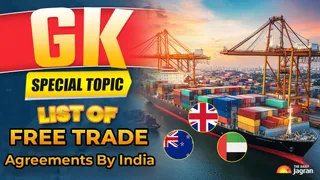
India's Free Trade Agreements: Today, we bring you one of the most significant current affairs topics of the month, as today, July 15, 2026, marks a historic day for India's trade diplomacy. The India-UK Comprehensive Economic and Trade Agreement (CETA) comes into effect today, opening up duty-free or preferential access for approximately 99 percent of Indian exports to the UK.
To mark this significant occasion, we have compiled a comprehensive list of countries with which India has signed Free Trade Agreements (FTAs) over the past few years.
This topic is important for aspirants preparing for UPSC, SSC, Railway, Banking, and other state government examinations, as questions regarding India's FTAs and international trade frequently appear in the economics and current affairs sections of these exams.
ALSO READ: Karnataka Unveils Big AI Push: CM Announces India’s First Government-Led AI University
What is An FTA?
A Free Trade Agreement (FTA) is an agreement reached through mutual negotiation between two or more countries or regional blocs to reduce or eliminate trade barriers, such as tariffs and duties, thereby boosting trade between them. Such agreements can be comprehensive in scope, encompassing not only goods but also services, investment, intellectual property, competition, and government procurement.
List Of Free Trade Agreements Signed By India Till July 2026
FTA/CEPA | Countries/Region | Year |
SAFTA | South Asian Free Trade Area | 2006 |
ASEAN-India Trade in Goods | ASEAN Nations | 2010 |
India-Mauritius CECPA | Mauritius | 2021 |
India-UAE CEPA | UAE | 2022 |
India-Australia ECTA | Australia | 2022 |
India-EFTA TEPA | Iceland, Liechtenstein, Norway, Switzerland | 2024 |
India-Oman CEPA | Oman | 2025 |
India-New Zealand FTA | New Zealand | 2025 |
India-UK CETA | United Kingdom | 2026 |
India-EU FTA | European Union | 2026 |
Why Is Free Trade Agreements Important For India?
-FTAs directly boost labour-intensive sectors like textiles, leather, gems, jewellery and footwear, creating jobs and export opportunities across India.
-Agreements like the India-Oman CEPA and India-UK CETA allow long-term stay and mobility for Indian professionals abroad, along with visa quotas for workers.
-FTAs support India's "China Plus One" strategy, helping the country diversify its supply chains and reduce dependence on a single trading partner.
-MSMEs, which contribute nearly 50 per cent of India's exports, get better integration into the global economy through these trade partnerships.
-These agreements attract greater foreign investment inflows and help India secure critical minerals and energy resources from partner nations.
For more such general knowledge stories, stay tuned to The Daily Jagran.