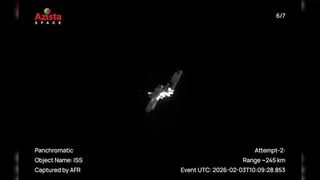
Private space manufacturing firm Azista Industries Pvt Ltd, has achieved a major breakthrough in India’s space exploration with the new ‘orbit snooping’ capabilities. The Ahmedabad-based company successfully captured images of the International Space Station (ISS), becoming the first Indian private firm to do so. The breakthrough marks an important advance in India’s space situational awareness and orbital monitoring capabilities.
The experiment was conducted on February 3 in two carefully planned orbital passes. The satellite, weighing just above 80 kilograms, was tasked with tracking the fast-moving ISS in challenging conditions near the horizon and under sunlight. The satellite was launched on June 13, 2023, aboard SpaceX’s Falcon 9 rocket. The satellite was launched for a period of five years, with another 2.5 years of mission life remaining.
ALSO READ: India Moves Closer To Rs 3.25 Lakh Crore Mega Deal For 114 Rafale Fighter Jets Ahead Of Macron Visit
The first pass was executed at a distance of approximately 300 kilometres, while the second one was conducted at a distance of about 245 kilometres. According to the company, the satellite successfully captured 15 separate images of the ISS with an imaging sampling of 2.2 metres with 100 per cent accuracy. This validated both the sensor performance and the indigenous tracking algorithm.
Why Is This Mission Important?
According to the company officials, the mission is important for the foundation of monitoring complex orbital objects and targets. Tracking the ISS, though an easy target, has been an important proof-of-concept for developing complex tracking space equipment.
ALSO READ: Pakistan Launches Massive Crackdown In Balochistan After Clashes, 180 Detained
The capability showcased by AFR lies in the realm of non-Earth orbital imaging, often colloquially termed “in-orbit surveillance.” Strategically, such capabilities are integral to Space Situational Awareness (SSA), the capacity to identify, track, and assess the activities and behaviour of objects in space. As orbital environments grow increasingly congested and competitive, SSA has evolved into a foundational pillar for modern space powers.
India today operates nearly 50 satellites across various sectors spanning communication, navigation, Earth observation and other strategic domains. Cumulatively, these 50 satellites are valued at over Rs 50,000 crore. Naturally, protecting these crucial assets required timely awareness and complex monitoring capabilities for protection, capabilities that become indispensable in an increasingly congested and contested orbital environment.