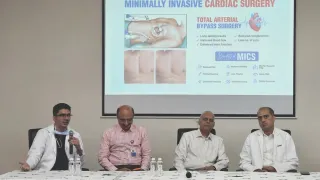
In a significant advancement in cardiac care, Sagar Multispeciality Hospital (SMH), located on Narmadapuram Road, Bhopal, has successfully performed multiple heart bypass surgeries using the minimally invasive cardiac surgery technique at its Advanced Cardiac Centre.
The advanced technique allows surgeons to access the heart through a small 3-4-inch incision on the left side of the chest, without cutting the breastbone. For appropriately selected patients, this approach may offer benefits such as reduced postoperative pain, less discomfort and relatively faster recovery compared with conventional open-heart surgery.
Dr Sanjeev Gupta, Consultant for Cardiothoracic and Vascular Surgery Services at the SMH, stated that the specialist team at SMH, which includes Consultant Cardiac Anaesthetist Dr Anuj Kapoor and Assistant Surgeon Dr Manish Sahu, has successfully treated patients by performing multiple heart bypass surgeries using minimally invasive techniques.
The initiative aims to make advanced cardiac surgical care accessible to patients in Bhopal and surrounding areas, reducing the need to travel to other metropolitan cities for such treatment. He explained that the technique may be a suitable option for select patients, including elderly individuals and patients having diabetes or other medical conditions that require special attention during postoperative recovery.
However, the choice of surgical technique depends on the patient’s cardiac condition, the nature and location of the blockages, overall health and other clinical factors, as assessed by the specialist team.
Accessing The Heart Through Small Incision
In conventional open-heart bypass surgery, the breastbone is generally divided to provide access to the heart. In minimally invasive cardiac surgery, the surgeon accesses the heart through a small incision on the left side of the chest, generally avoiding the need to cut the breastbone.
During bypass surgery, an alternative route is created for blood to flow around blocked or narrowed coronary arteries. Depending on the patient’s condition and surgical requirements, arterial grafts or veins may be used to establish this alternative pathway. The objective is to provide effective surgical treatment while minimising surgical trauma where clinically appropriate.
Less Pain And Potentially Faster Recovery
One of the key advantages of the minimally invasive approach is the smaller incision and avoidance of cutting the breastbone. In appropriately selected patients, this may help reduce postoperative pain and discomfort and facilitate an earlier return to routine activities. The smaller incision also generally results in a smaller surgical scar.
ALSO READ: From Doctor's Appointment To Test Reports, AIIMS Bhopal Launches Services On WhatsApp For Patients
Depending on the patient’s overall health, the complexity of the procedure and postoperative recovery, hospital discharge may be possible within approximately 4–5 days in selected cases. However, the length of hospital stays and the time required for complete recovery vary from patient to patient.
Case 1: Successful Minimally Invasive Bypass Surgery in a 44-Year-Old Patient
Dr Sanjeev Gupta shared the case of a 44-year-old male patient who presented with coronary artery blockages and difficulty walking. The patient was reluctant to undergo conventional open-heart surgery. Following detailed clinical evaluation, the medical team performed a successful heart bypass surgery using the minimally invasive technique.
The patient underwent Total Arterial Revascularisation, an advanced cardiac surgical approach that uses arterial grafts to restore blood flow to the heart. In this case, the surgical team used a single graft to bypass multiple blockages in the affected artery, as planned based on the patient’s clinical condition. The patient showed improvement following surgery and was discharged from the hospital within approximately 4-5 days.
Regular Follow-Ups And Medication Are Essential
Dr Sanjeev Gupta emphasised that heart bypass surgery is a complex procedure and that every patient’s condition is different. He advised patients to follow their treating doctor’s instructions, take prescribed medicines regularly, attend scheduled follow-up appointments and adopt the necessary lifestyle modifications. He further emphasised that the choice of surgical technique must always be based on a comprehensive clinical evaluation and the recommendations of the treating specialists.
The Advanced Cardiac Centre at Sagar Multispeciality Hospital continues to focus on providing modern cardiac treatment and specialised medical services to patients in Bhopal and neighbouring regions. These successful minimally invasive bypass surgeries reflect the hospital’s ongoing efforts to make advanced cardiac surgical care accessible to patients closer to home.