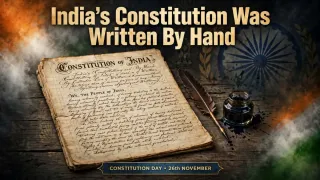
Constitution Day: India celebrates Constitution Day on November 26 every year to mark the adoption of its Constitution in 1949. While the document laid the foundation for the world's largest democracy, not many people know that its original version was neither typed nor printed. Instead, it was handwritten in elaborate calligraphy and decorated with illustrations depicting different periods of Indian history.
The original Constitution was prepared in both English and Hindi, with nearly 90,000 words. It was not just a legal document but also a work of art, with several people contributing to its creation.
From the calligrapher who wrote every word by hand to the artists who decorated its pages, the making of the original Constitution was a remarkable effort.
But why was the Constitution handwritten instead of printed? Who took up the task of writing hundreds of pages by hand? And where is the original document preserved today? Here's everything to know about the story behind India's handwritten constitution.
Why Was India's Constitution Handwritten?
When the Constituent Assembly adopted the Constitution on November 26, 1949, the original document was prepared entirely by hand rather than printed.
This was a deliberate decision to give India's founding document a distinctive appearance. Instead of being treated as an ordinary legal text, the Constitution was designed as a manuscript that reflected the country's history, culture and identity.
Its pages featured illustrations inspired by different periods of Indian civilisation. These included scenes from the Ramayana and Mahabharata, images of historical rulers and leaders, and moments from India's freedom struggle.
The idea was to give the Constitution a visual identity that represented India's rich cultural heritage and historical journey. However, there was no constitutional requirement to handwrite the document. It was a conscious choice to create an original manuscript with artistic and historical value.
Who Wrote India's Constitution By Hand?
The task of writing the English version of the Constitution was given to Prem Behari Narain Raizada, a well-known calligrapher from Delhi who originally belonged to Rampur, Uttar Pradesh.
Raizada was entrusted with writing the entire document by hand because of his calligraphy skills. He began the work on November 28, 1949, just two days after the Constituent Assembly adopted the Constitution, and completed it in April 1950.
He carefully wrote every page using his calligraphy skills without a typewriter or printing machine.
The Hindi version of the Constitution was also handwritten as part of the effort to preserve the original document in both languages.
Who Designed The Pages Of The Constitution?
While Prem Behari Narain Raizada was responsible for the calligraphy, the artistic work was led by renowned artist Acharya Nandalal Bose from Santiniketan, West Bengal.
Bose, along with a team of artists from Santiniketan, decorated the Constitution with 22 illustrations representing different periods of Indian history. The artwork traced India's journey from the Indus Valley Civilisation to the freedom movement.
The illustrations included scenes from the Ramayana and Mahabharata, along with depictions of Lord Buddha, Lord Mahavira and historical rulers such as Emperor Ashoka, Akbar and Chhatrapati Shivaji Maharaj.
Other important figures featured in the artwork included Guru Gobind Singh, Rani Lakshmibai and Tipu Sultan.
The pages dedicated to India's freedom struggle featured illustrations of Mahatma Gandhi's Dandi March and Subhas Chandra Bose.
Most of these illustrations were created in the miniature art style. Each one represented a particular period of Indian history and highlighted its contribution to the country's cultural identity.
The artwork gave the Constitution a distinctive appearance, making it much more than an ordinary legal document.
Why Was The Constitution Not Printed Initially?
Although the original Constitution was handwritten, printed copies were produced later to make the document available for wider use.
The handwritten manuscript remained the original version, while printed copies allowed government institutions and others to access and refer to its provisions more easily.
According to historical records of the Parliament Secretariat, the Survey of India printed 1,000 offset copies of the Constitution in Dehradun in 1955.
The printing process took around one-and-a-half years and cost Rs 70,000. Another Rs 25,000 was spent on binding the copies.
This meant that the Constitution was not kept in handwritten form for all official use. Printed versions were introduced later, while the original manuscript continued to be preserved as an important historical document.
Today, the original handwritten copies of the Constitution are kept in special nitrogen-filled chambers in the Library of Parliament to protect them from damage and deterioration.
About the Indian Constitution
Constitution Day, also known as Samvidhan Divas, is celebrated on November 26 every year to mark the adoption of the Indian Constitution by the Constituent Assembly in 1949.
Although it was adopted on November 26, 1949, the Constitution came into effect on January 26, 1950. This is why India celebrates Republic Day on January 26 every year.
The government officially declared November 26 as Constitution Day in 2015 to mark the 125th birth anniversary of Dr BR Ambedkar, who chaired the Drafting Committee.
The Constitution is the world's longest written national constitution. At the time it came into force, it had 395 Articles, 22 Parts and eight Schedules.
A total of 284 members of the Constituent Assembly signed the Constitution on January 24, 1950, at the Constitution Hall in Parliament House, New Delhi.
The Constituent Assembly held its final meeting on the same day, during which Dr Rajendra Prasad was announced as India's first President.
The Assembly also had 15 women members who played an important role in shaping the country's founding document. They included Sarojini Naidu, Rajkumari Amrit Kaur, Hansa Mehta, Sucheta Kripalani and Durgabai Deshmukh.