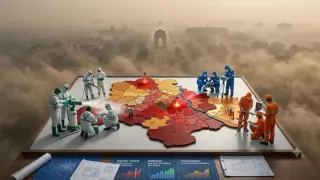
Delhi is working on measures to combat air pollution across the NCR by adopting strategies based on individual hotspots and major sources of pollution rather than a uniform approach for the entire region. The Commission for Air Quality Management (CAQM) has directed all states in the NCR and the Delhi government to prepare specific action plans for identified hotspots and implement them in a timely manner.
CAQM Member Secretary Tarun Kumar Pithode recently held a review meeting regarding the plan. In the meeting, officials from the NCR's State Pollution Control Boards, the Delhi Pollution Control Committee (DPCC), and relevant enforcement agencies provided information on the identification of hotspots and their updates, prepared action plans, and measures being taken to address various sources of pollution.
The Commission's focus now is on determining the source of pollution in a hotspot before taking action at that source. Therefore, source-specific measures will be implemented in the national capital, such as dust control in areas with road dust, monitoring of construction sites in areas with construction activity, and preventing open burning of garbage in areas with waste burning.
The CAQM has advised against limiting hotspot action plans to mere preparation. The relevant agencies and departments have been instructed to implement them in a timely manner and update them regularly in order to be able to review the impact of measures taken in a particular area and adjust the strategies as per needs.
The Commission's move aims to make pollution control more local and accountable. Currently, multiple sources may be responsible for pollution within a large area, but uniform measures are not effective everywhere. A hotspot-based plan requires relevant agencies to determine which source is contributing to pollution in which area and what action is taken to address it.
The CAQM has urged the states, the Delhi government and enforcement agencies to keep hotspot identification updated, regularly implement action plans, and strictly monitor them, while also taking direct action against the actual source of local pollution.
(With Inputs From Sanjay Gupta, New Delhi)