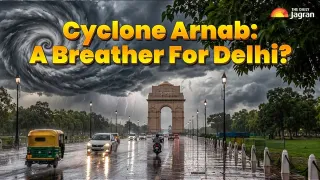
Although Cyclone Arnab is nearly 1,500 kilometres away, its impact has been felt across Delhi-NCR since Thursday. Several areas, including Noida, Ghaziabad and Gurugram, witnessed sudden spells of rainfall, followed by overnight showers. The region woke up to a pleasant Friday morning, with cooler temperatures bringing a hint of the approaching winter.
Delhi recorded a minimum temperature of 17.2 degrees Celsius. The rainfall marked the highest precipitation for October since 2022, making it the wettest October day in this period. Meanwhile, the Air Quality Index (AQI) also improved, offering some relief to residents struggling with deteriorating air quality.
With Diwali approaching, however, concerns over pollution remain. Several factors will determine Delhi's air quality in the coming days, including meteorological conditions, stubble burning in neighbouring states, vehicular emissions, construction dust and firecracker emissions.
While the rainfall associated with Cyclone Arnab has temporarily improved air quality across Delhi-NCR, raising hopes of cleaner air ahead of Diwali, the bigger question remains: will this improvement last, or is the capital witnessing only a brief respite before pollution levels rise again?
To understand whether Cyclone Arnab has provided Delhi with meaningful relief from pollution or merely delayed the seasonal deterioration in air quality, The Daily Jagran spoke with Dr Sandip Singh, Assistant Professor (Environmental Sciences), Department of Chemistry, Lovely Professional University, and Maninder Singh Nayyar, Founder and CEO of CEF Group, an Indian company working in climate change, renewable energy and waste management.
Will Delhi Breathe Easier This Diwali?
Every year, as October draws to a close, Delhi begins preparing for another challenging winter marked by deteriorating air quality. For residents of Delhi-NCR, checking pollution levels before stepping outdoors has become an unfortunate annual routine.
The recent spell of rainfall, however, has brought some temporary relief. The interaction between Cyclone Arnab and a western disturbance resulted in rainfall and falling temperatures, while AQI levels also improved to the moderate category.
Dr Sandip Singh said, "A few days of cleaner air should not give us the impression that the problem is easing. Rain helps settle dust and wash some pollutants out of the atmosphere, while stronger winds help disperse them. But these effects do not last forever. As soon as weather conditions become normal again, pollution levels can rise."
ALSO READ: Why Did Sky Turn Blood-Red Over Chhattisgarh's Kirandul? The Science Behind The Rare Phenomenon
He further explained that the improvement being witnessed is largely weather-driven rather than the result of any lasting change in pollution-control efforts.
He also pointed out that the temporary relief offered by rainfall and changing weather conditions should not be mistaken for a long-term improvement in air quality. Concerns have also been raised in judicial observations about the likelihood of pollution levels deteriorating again after Diwali.
According to IMD, the cyclonic rainfall and cloudy conditions are expected to clear by October 31. From November 1 onwards, Delhi-NCR is likely to experience typical winter weather conditions, when atmospheric inversion can trap pollutants closer to the ground.
Explaining the factors contributing to Delhi's pollution, Dr Singh stressed that the city's air quality crisis cannot be attributed to a single source. Vehicle emissions, construction activities, industrial pollution, waste burning and stubble burning in neighbouring states collectively contribute to the problem.
During winter, low temperatures, reduced wind speeds and atmospheric inversion make matters worse by trapping pollutants closer to the ground. Firecrackers add another layer of pollution to an already difficult situation. Their emissions release fine particulate matter and harmful gases into the atmosphere, potentially causing pollution levels to rise considerably within a short period.
Similarly, Maninder Singh Nayyar also said that the current improvement in Delhi-NCR's air quality is welcome but temporary.
"The relief Delhi-NCR is experiencing right now is welcome, but it is borrowed. Cyclone Arnab, along with the western disturbance interacting with it, has brought stronger winds and rain across the region, dispersing pollutants and pulling the AQI back from the “very poor” zone. This is a weather-driven reprieve, not a structural improvement, and we must be careful not to mistake one for the other."
Explaining how rainfall helps improve air quality, he said, "Rain acts as nature’s air purifier. It washes particulate matter out of the atmosphere, while brisk winds break up the stagnant layer that normally traps smoke and dust close to the ground. But the effect is short-lived."
He further cautioned, "Once the system moves on, winds slow, nights turn cooler, and the region re-enters its winter inversion window, when emissions from vehicles, construction dust, industry, crop residue burning and festive firecrackers accumulate rapidly. With Diwali approaching, a clean-air week can slip back into a poor-air week within days."
Nayyar stressed that Delhi's air quality challenge is primarily an emissions problem, with meteorological conditions further worsening the situation. He emphasised that the city cannot depend on favourable weather systems to address a problem that requires consistent policy interventions, technological solutions and responsible public behaviour throughout the year.
People Should Celebrate Diwali Without Worsening Air
With Diwali approaching, Nayyar urged citizens to celebrate with diyas, rangoli, LED lights and community gatherings instead of firecrackers. He also advised people to avoid burning waste, carpool or use public transport during the festive rush, and ventilate their homes when the air is clearer.
Small collective choices matter most, precisely when the weather has given us a head start.
Conclusion
So, will Delhi breathe easier this Diwali? It can, but only if the relief the rain has offered is followed by responsibility from all of us. The weather may offer the pause; sustained, cleaner choices must deliver the progress.
Cyclone Arnab may have temporarily cleared the air, but it cannot address the underlying sources of pollution. As Delhi prepares for Diwali and another challenging winter, the responsibility lies with governments, industries and citizens to ensure that cleaner air is not merely a temporary seasonal phenomenon.