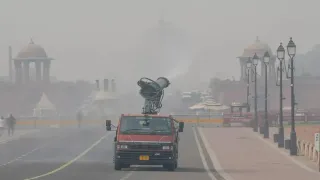
A day after Diwali, Delhi residents woke up to a thick layer of smog covering the city. A grey haze hung over the skyline, visibility on roads reduced, and many people complained of irritation in their eyes and throat. Pollution levels remained high on Monday after firecrackers were burst across the city well beyond the permitted hours on Diwali night.
Delhi-NCR has been facing poor air quality for the past week, but pollution levels rose further during Diwali celebrations. However, as pollution peaked on Sunday night, several air quality monitoring stations suddenly stopped showing real-time data. This raised questions about why the readings were no longer available when pollution levels were at their highest.
According to an NDTV report, several areas in Delhi recorded pollution levels much higher than usual. RK Puram and Nehru Nagar, near Lajpat Nagar, were among the most polluted areas at 9 pm. The available data showed a sharp rise in pollution levels before the readings stopped appearing.
The RK Puram monitoring station stopped showing data after 9 pm, when the PM2.5 concentration reached 924 micrograms per cubic metre. This was almost double the reading of 504 micrograms per cubic metre recorded an hour earlier, the report said.
The Delhi Pollution Control Committee (DPCC) website stopped showing real-time data from several monitoring stations, including RK Puram, Nehru Nagar, Mundka, Sonia Vihar and Dwarka, for the next few hours.
Meanwhile, data from the Jawaharlal Nehru University (JNU) monitoring station remained available online. It showed that PM2.5 levels reached 786 micrograms per cubic metre by 11 pm on Diwali night, almost five times the level recorded at 8 pm.
ALSO READ: Delhi Post-Diwali AQI: Did The Air Get Cleaner Or Worse? What 3 Years Of Data Reveal
The sudden disappearance of pollution data raised questions about the monitoring of air quality during Diwali. It also brought attention to the implementation of the Supreme Court's guidelines on bursting firecrackers.
On Monday morning, Delhi's overall Air Quality Index (AQI) stood at 370, placing it in the 'very poor' category, according to the Central Pollution Control Board (CPCB).
However, other air quality monitoring platforms reported much higher readings. According to open-source monitoring platform AQI.in, Delhi's AQI rose to 2,283 after Diwali. The platform recorded an AQI of 637 on Monday morning, which it classified as "hazardous".
Similarly, data from Swiss air quality monitoring platform IQAir showed that Delhi's PM2.5 concentration stood at 170 micrograms per cubic metre (µg/m³), around 34 times the World Health Organization's (WHO) annual guideline value.
The difference in readings reported by these platforms has also raised questions about the accuracy and consistency of air quality data in the national capital.
Meanwhile, firecrackers were burst across Delhi on Diwali night despite restrictions on their use. Twenty monitoring stations recorded 'severe' air quality, with Sonia Vihar recording the highest AQI at 463, followed by Jahangirpuri at 450.
Firecrackers were being burst from around 5-6 pm on Sunday in areas such as Pitampura, Burari, Mayur Vihar and parts of Lutyens' Delhi. As celebrations continued late into the night, smoke spread across roads and residential areas, adding to the city's pollution.