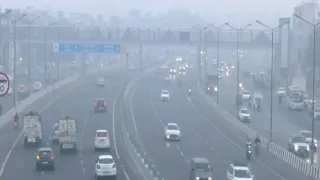
Delhi residents may want to rethink their winter outdoor schedules. The capital's air pollution levels can nearly double between afternoon and late evening, with 10 pm emerging as the most polluted hour and 4 pm offering a relatively cleaner window, an eight-year analysis by think tank Envirocatalysts has found.
The analysis of hourly data from Delhi's monitoring stations between 2018 and 2025 found that average winter PM2.5 concentrations stood at 114 micrograms per cubic metre around 4 pm, rising to 211 micrograms per cubic metre by 10 pm.
The worst period also varies with the season. In October and November, pollution levels typically peak around 9 am, making early morning outings another concern for residents.
Why Afternoons Offer Relatively Cleaner Air
This stems mostly from the atmospheric mixing layer, which controls the general dispersion of pollutants.
During winter nights, this layer often shrinks to less than 100 metres, trapping emissions close to the ground. By midday, it can expand to nearly a kilometre, allowing pollutants to spread through a much larger volume of air.
Traffic at night, trucks coming into the city and bonfires contribute to the pollutant load.
Why Fewer Vehicles Are Not Enough
The analysis also shows why traffic reduction alone will not fix Delhi's pollution.
Sunil Dahiya, founder and chief analyst at Envirocatalysts, as cited by Jagran.com, said nitrogen dioxide levels decrease by approximately 20 per cent on Sundays once weather variations are factored in. PM2.5 levels only decrease by 2.5 per cent.
On most public holidays such as on the Republic Day, the Independence Day, Gandhi Jayanti and Christmas, the nitrogen dioxide decreases by close to 13 per cent, whereas the particulate depend by 10-12 per cent.
This indicates the important contribution of sources that do not stop operating when holidays end, such as industries, power plants, and pollution and dust emissions from neighbouring states.
November Remains The Most Polluted Month
November records the highest average PM2.5 concentration at 219 micrograms per cubic metre, followed by December at 199 and January at 180. August is the cleanest month, with an average of 34.
Also, the haze that is generated by firecrackers and stubble burning, combined with the colder and still nights, leads to November being worse.
While weather is responsible for approximately two-thirds of day-to-day pollution variations, the worst days in November and January still see average PM2.5 levels of nearly 150 micrograms per cubic metre, 2.5 times the national standard.
Rain Brings Relief, But Emissions Remain Unchanged
Between January 1 and November 15 this year, average PM2.5 levels across the same 30 older monitoring stations stood at 80 micrograms per cubic metre, marginally below 82 recorded during the corresponding period last year.
October had 114 mm of rain this year, with an average PM2.5 reading of 78 compared with 112 last year.
But once weather conditions are factored in, pollution levels are roughly equal to last year's, indicating that the monsoons rather than a permanent cut to emissions have caused most of the decrease.
When Should You Step Outside?
Meanwhile, the analysis indicates that outdoor walks, runs, and kids' play should be scheduled between 1 pm and 5 pm during winter, when pollution is usually lower.
Also monitor hourly air quality readings before venturing outside, shut windows during the night and early morning, and wear an N95 mask and run an air purifier in your bedroom during days when pollution levels soar.