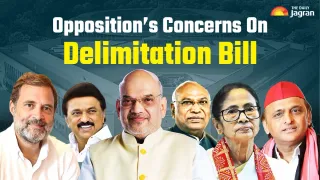
The BJP government has announced a four-day Parliament session from November 30 to December 3. This has led to speculation that the government may reintroduce the Delimitation Bill and the Constitutional Amendment Bill linked to 33 per cent reservation for women.
The proposed delimitation exercise has become a major point of disagreement between the government and the Opposition.
While the Centre says that increasing the number of Lok Sabha seats will improve representation and help implement women's reservation, Opposition parties have raised concerns about its impact on states, federalism and caste representation.
Congress General Secretary KC Venugopal has accused the Central government of undermining the Constitution. Samajwadi Party chief Akhilesh Yadav has also criticised the proposed exercise, calling it a major political mistake by the BJP.
But why is the Opposition against the proposed delimitation exercise?
Here are five major concerns
1. Fear of a North-South imbalance
One of the biggest concerns among Opposition parties is that northern states could gain more Lok Sabha seats, while southern states could lose their share of representation.
Southern states such as Tamil Nadu, Kerala, Karnataka, Telangana and Andhra Pradesh argue that they should not be penalised for implementing family-planning policies and investing in healthcare and education.
The distribution of Lok Sabha seats among states was frozen based on the 1971 Census. The aim was to ensure that states which controlled their population growth would not lose political representation.
The proposed exercise seeks to change this arrangement by increasing the number of Lok Sabha seats from 543 to potentially 850 and redistributing them based on population figures.
Tamil Nadu is particularly concerned about this change. The state currently has 39 Lok Sabha MPs, accounting for 7.18 per cent of the House. Under the proposed changes, its seats could increase to around 50, but its overall share could fall to 5.88 per cent.
At the same time, states such as Uttar Pradesh, Bihar, Rajasthan and Madhya Pradesh are expected to gain significantly.
Overall, the Hindi heartland's share could increase from 38.1 per cent to 43.1 per cent, while the South's share could decline from 24.3 per cent to 20.7 per cent, reported the Hindu.
This explains why Tamil Nadu has been raising concerns about delimitation for several years. However, Union Home Minister Amit Shah has said that no state will be disadvantaged by the exercise.
For example, Uttar Pradesh's Lok Sabha seats could increase from 80 to 140, while Tamil Nadu's could rise from 39 to 51. These are illustrative projections and not a final seat-allocation formula.
The DMK has been particularly vocal about protecting Tamil Nadu's parliamentary representation. Its concern is that population-based redistribution could increase the political influence of northern states at the expense of southern states.
2. Fear that the BJP could benefit politically
The second concern is that the delimitation exercise could change the political balance in Parliament in favour of the BJP.
Opposition leaders have alleged that the proposed changes could benefit the ruling party by increasing the number of seats in states where it has a strong electoral presence.
Congress leader Rahul Gandhi has accused the government of trying to redraw constituencies in a way that could favour the BJP.
Other Opposition leaders have also questioned whether there will be enough safeguards to ensure that the exercise remains fair.
The government, however, says that the purpose of delimitation is to improve representation and not to benefit any political party.
The Opposition has demanded a clear and transparent process, along with wider discussions with political parties and state governments.
3. Opposition questions BJP linking women's reservation with delimitation
The Opposition has repeatedly said that it supports 33 per cent reservation for women in Parliament and state Assemblies but disagrees with making its implementation dependent on a fresh delimitation exercise.
The Women's Reservation Act was passed unanimously in Parliament in 2023. However, its implementation was linked to a Census followed by delimitation.
Congress and other Opposition parties argue that women's reservation should be implemented without waiting for the redistribution of constituencies. They have proposed reserving 182 seats for women in the existing 543-member Lok Sabha.
The Opposition has accused the government of using the issue of women's reservation to push through a wider delimitation exercise.
The BJP, on the other hand, has argued that increasing the number of parliamentary seats would create more opportunities for women in Parliament.
This disagreement has become one of the central points of the political confrontation between the government and the Opposition.
4. Fear that caste representation could be ignored
Another major concern, especially for the Congress and the Samajwadi Party, is the lack of clarity on caste-based representation.
The Opposition wants delimitation to take place after the Census and the availability of caste-related population data.
It argues that the representation of OBCs, Dalits and other disadvantaged communities must also be considered.
Samajwadi Party chief Akhilesh Yadav has demanded a separate quota for OBC women within the proposed 33 per cent reservation for women.
The party argues that women from all communities do not have equal access to political power. Without proper safeguards, women from disadvantaged communities may not get a fair share of representation.
The Congress has also raised concerns about the representation of OBCs, Dalits and Adivasis.
The Opposition's concern is not just about how many seats each state gets but also about whether different communities get fair representation in Parliament.
5. Questions over the Delimitation Commission and lack of consultation
The fifth concern is about the powers of the Delimitation Commission and the way the exercise will be carried out.
Under the proposed framework, the Central government would appoint the commission's chairperson, who must be a serving or former Supreme Court judge.
The commission would also include the Chief Election Commissioner or a nominated Election Commissioner and the concerned State Election Commissioner.
Opposition parties have questioned whether the commission will have enough safeguards to ensure a fair process.
They have also demanded discussions with political parties and state governments before any decision is taken on the redistribution of seats.
ALSO READ: DMK's Stand On Delimitation Bill In Focus Amid Rift With Congress Ahead Of Parliament Session
Another concern is the use of the 2011 Census. The Opposition has questioned why such a major exercise should be carried out without waiting for updated population data.
The government, however, says that increasing the number of Lok Sabha seats will improve representation and help implement women's reservation.
What does the Opposition want?
The Congress-led Opposition has made four major demands:
- Keep the Lok Sabha's existing strength of 543 seats.
- Protect the current distribution of seats among states.
- Implement 33 per cent women's reservation in the existing Lok Sabha.
- Continue the freeze on the distribution of seats for another 25 years.
- The Opposition believes that women's reservation should be implemented separately and should not depend on delimitation.
Can the Bill be passed?
Delimitation is the process of redrawing constituency boundaries and reallocating Lok Sabha seats based on population. The proposed Delimitation Bill aims to increase the number of Lok Sabha seats to 850.
The Bill requires a two-thirds majority in the Lok Sabha, which would mean 361 votes in a 543-member House. With three vacancies, the House currently has 540 members.
The ruling NDA has around 320 members and would need support from outside its alliance to cross the required threshold.
Since the Bill's defeat in April, the political arithmetic has changed, with 26 MPs moving out of the Opposition camp. Twenty of the Trinamool Congress's 28 Lok Sabha MPs who broke away from the party have said they will support the delimitation Bill.
Six of the nine Shiv Sena (UBT) MPs have joined the BJP-allied faction of the Shiv Sena.
The Shiromani Akali Dal, which has one Lok Sabha MP, joined hands with the BJP earlier this week for the upcoming Punjab elections and is likely to support the party.
The DMK, which has 22 Lok Sabha MPs, has indicated that it might support the Bill if the government gives written assurances that Tamil Nadu's seats will increase proportionately.
The YSR Congress Party (YSRCP) is also likely to support the Delimitation Bill, provided it ensures regional balance, according to ANI, citing party sources.
If a few smaller parties also support the Bill, the NDA's numbers could reach around 355-357, still short of the required 361 votes.