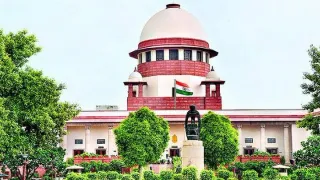
The Solicitor General, Tushar Mehta, on Thursday sought to clarify in the Supreme Court that the Centre and its instrumentalities, like Delhi Police and DMRC, defended their actions in affidavits filed in response to the contempt notices, rejecting media reports that the government had apologised.
The Supreme Court also echoed the similar sentiment, saying that it was not taking cognisance of media reports suggesting that government authorities tendered unconditional apologies in contempt proceedings over alleged violations of its directions concerning Metro and train services in Delhi during a protest against SIR on October 10.
A bench comprising Chief Justice Surya Kant and Justice Joymalya Bagchi made the observation after Mehta sought to clarify the Centre's stance.
Solicitor General Explains Norms
The Solicitor General, explaining the drafting norms, said the affidavits filed by the Union Home Secretary, DMRC and Delhi Police start with the averments that unconditional apologies are tendered. Media headlines and social media posts were portraying the affidavits as admissions of wrongdoing, without taking into account the explanations and justifications provided by the authorities, he told the top court.
"I am not on the merits of the matter. I want to say something other than that, if the other side permits. The court has issued notice in contempt. We have filed responses in the contempt matters. The law is well settled that whenever we file a response to a contempt notice, the first sentence we write is that we hereby tender an unconditional apology, and thereafter we explain how contempt has not been committed," the Solicitor General clarified.
"It is in compliance with that law that this is the first paragraph in every affidavit. But now, in the media and on social media, it is being said that the government has apologised, that they have nothing to say. I want to clarify that the government has defended its actions, and the first paragraph is in compliance with the law laid down by this court," the law officer said.
Media Coverage Was Not Relevant To The Court's Proceedings: CJI
The CJI responded that media coverage was not relevant to the court's proceedings. "What the media does is not relevant. We are not holding proceedings for the media," the CJI said. Justice Bagchi then said the court was not taking cognisance of the unqualified apology referred to by the Solicitor General, adding that, in view of Mehta's submissions, the apology appeared to be qualified.
Mehta, however, said that the apology was unconditional and that the affidavits subsequently set out the relevant facts and reasons for the authorities' actions.
"It is an unconditional apology. Thereafter, I have given the reasons. Thereafter, I have given the facts. That's all," he said. The contempt proceedings relate to allegations that authorities violated the Supreme Court's October 9 directions to ensure there was no "complete prohibition" on Metro and train services in Delhi in view of the October 10 protest called by the Cockroach Janta Party (CJP).
(With PTI Inputs)