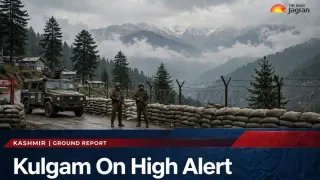
A series of terror-related incidents in Kulgam over the past two years has brought the South Kashmir district back into focus. From the killing of retired Army personnel and migrant workers to prolonged encounters in forest areas and attacks on security forces, the district has witnessed several security challenges since 2025.
The latest incident took place on November 11, when two suspected terrorists riding a motorcycle opened fire at a Central Reserve Police Force (CRPF) checkpoint in the Nowpora Akhran area near Mir Bazar. Three CRPF personnel were injured in the attack.
According to ANI citing sources, the attackers had planned a major strike. However, security forces were already deployed at the checkpoint following intelligence inputs, which helped prevent further damage.
Meanwhile, in a separate incident, the bullet-riddled bodies of two missing Special Police Officers (SPOs) were found in the higher reaches of Dachhan in Kishtwar district on Thursday. Their service weapons were also missing, raising suspicion of a possible terror angle.
On November 12, security forces also arrested a man in Baramulla and recovered two hand grenades from him. Following these incidents, security forces have been put on high alert across the Valley.
This has raised concerns about terror activities in the district and whether terrorist groups are increasingly targeting both civilians and security personnel.
Against this backdrop, here is a look at the major terror-related incidents reported in Kulgam since 2025.
Terror-Related Incidents in Kulgam Since 2025
February 3, 2025: Retired Territorial Army soldier killed in Behibagh
One of the major terror attacks in Kulgam in 2025 took place on February 3, when terrorists shot dead retired Territorial Army soldier Manzoor Ahmad Wagay in the Behibagh area. His wife and 13-year-old niece were also injured.
According to officials, two terrorists armed with pistols reached Wagay's residence and opened fire. Wagay sustained multiple bullet injuries while trying to protect his niece. He later died from his injuries.
The attack raised concerns about the safety of former security personnel and their families in the Valley.
August 1-12, 2025: Prolonged encounter in Akhal forest
In August 2025, Kulgam witnessed a prolonged counter-terror operation in the Akhal forest area.
Security forces launched a search operation after receiving intelligence inputs about the presence of terrorists. A joint team of the Army, Jammu and Kashmir Police and CRPF carried out the operation, which later turned into an encounter.
Three terrorists were reported killed during the initial phase of the operation, while two Army personnel also lost their lives. The gunfight and search operation continued for several days in the dense forest area.
September 8, 2025: Two terrorists killed in Guddar forest encounter
Barely a month after the Akhal operation, another encounter broke out in the Guddar forest area of Kulgam on September 8.
Security forces launched a search operation after receiving information about the presence of two to three terrorists in the area. Terrorists hiding in the forest opened fire on security personnel, triggering a gunfight.
Two terrorists were killed in the encounter. However, two Army personnel also lost their lives, while another soldier was injured.
July 29, 2026: Weapons recovered from suspected terrorist hideout
Kulgam again came under the security spotlight in July 2026 after security forces recovered a cache of weapons and ammunition from an orchard between Sursunoo and Tantrypora.
Officials suspected that the hideout was linked to Hizbul Mujahideen and may have been used to store weapons for future terrorist activities.
July 31, 2026: Two migrant workers killed in Kellam
Two migrant workers from Chhattisgarh were shot dead in the Kellam area of Kulgam on July 31.
The victims, identified as Deepak Ratray and Bhupinder, were working at a brick factory when terrorists opened fire on them. Deepak died on the spot, while Bhupinder later succumbed to his injuries during treatment.
The Resistance Front (TRF) later claimed responsibility for the attack, according to reports.
November 11, 2026: Three CRPF personnel injured in checkpoint attack
In the latest incident, three CRPF personnel were injured after two suspected terrorists opened fire at a checkpoint in the Nowpora Akhran area near Mir Bazar.
Following the firing, security forces launched a search operation to trace the attackers. The area was cordoned off, and additional personnel were deployed.
Why is Kulgam Becoming New Terror Hotspot
To understand the repeated incidents in Kulgam and the security challenges facing the district, The Daily Jagran spoke to retired Major General Rajpal Punia, the orchestrator of Operation Khukri. He served in the Indian Army for 38 years and commanded one of the army's oldest brigades along the Line of Actual Control (LAC) with China.
Asked whether Kulgam was emerging as a new focus of terrorist activity in South Kashmir, Punia said the district's geographical location was one of the reasons behind the security concerns.
He explained that Kulgam is located in the foothills of the Pir Panjal range and lies along the left bank of the Veshaw River. The district shares its boundaries with Anantnag in the east and Shopian in the north. The Pir Panjal range separates it from parts of the Jammu division, including Ramban, Reasi and Rajouri.
According to Punia, the dense forests, difficult terrain and mountain passes make the region important from a security point of view. He said militant groups use the Pir Panjal corridor to move between the Jammu division and South Kashmir, making it difficult for security forces to monitor every route.
Comparing Kulgam with neighbouring districts such as Anantnag and Shopian, Punia said its geographical location makes it more vulnerable.
He also pointed out that Kulgam was earlier part of Anantnag district and that its access from the Pir Panjal side adds to the security challenge. He referred to the possibility of local support for militant groups, although this remains his assessment.
Speaking about the latest attack on CRPF personnel, Punia said the existing arrangements may need to be reviewed.
He stressed the need to strengthen intelligence networks and adopt a proactive approach rather than responding only after an attack takes place.
He said security forces need to maintain control over sensitive areas through regular patrolling and area domination.
'There is a need for CRPF to reinforce its proactive intelligence strategy. Being reactive to terrorist acts doesn't help."
Speaking about the broader security situation in South Kashmir and the possible challenges ahead, he said, "With the shift in traditional routes of infiltration from Shamshabari to Pir Panjal, South Kashmir assumes greater importance. The traditional shift of militancy from Kupwara and Baramula towards South Kashmir has happened in the recent past. It's a game of pressure; wherever you apply more pressure, as a result, the militancy flows into less pressure areas... We need a holistic approach towards militancy and more integration between the military and paramilitary."
On attacks targeting security personnel, he said, "Isolated attacks on Para Military have happened historically too. Need to beef up security of isolated posts, especially the ones looking into sensitive areas. A deterrence needs to be created by active patrolling and area domination of sensitive areas. Long-term measures and plans, rather than reactions to isolated incidents, hold the key."
Local Residents On Terror Attacks
The repeated incidents have also affected the sense of security among local residents, who fear that more attacks could take place.
Rakesh Raina, a Kashmiri Pandit who has been living in Amnoo, Kulgam, for more than 40 years, said the district has faced security challenges for a long time. He added that the latest attack had caused further distress.
Asked whether the attack had created fear among people, he said, "Certainly, any terror attack creates lots of chaos and confusion, and this attack on the security personnel who ensure our security is much more painful and gruesome."
On whether he had noticed any change in the security situation over the past year, Raina said there had been an improvement in the overall security situation in the Valley after Operation Sindoor.
Explaining why he believed Kulgam had witnessed several terror-related incidents, he said, "I think this area is full of lush green mountains and orchards, making it a safe habitat for such groups. Moreover, the presence of a few sympathisers helps the terrorists to carry out such cowardly attacks."
He also said security forces should remain alert even when the situation improves, as any relaxation could give terrorist groups an opportunity to strike.
A woman in her mid-20s from Chowgam, Kulgam, who did not wish to be named, said the incidents had made people question their safety.
She said, 'Honestly, such incidents make people question their safety.' She added that people try to continue with their daily lives, but the fear of another attack remains.
She said families, particularly parents, were worried about the possibility of such incidents happening again.
Speaking about the impact of repeated attacks, she said, "It is unfortunate that violence continues to affect ordinary people. The biggest change is the growing uncertainty among locals, who simply want to live without fear."
On what she expects from the administration and security agencies, she said, "The administration should strengthen preventive measures and improve coordination with local people. Security should be effective, but innocent civilians must never feel targeted or inconvenienced unnecessarily."
Another resident, Saiesh Pandita, said the latest attack had created fear and anxiety among families living nearby. He added that people were worried about their children's safety and the possibility of further incidents.
He said, "Repeated incidents have shaken people's confidence and sense of security. Ordinary Kashmiris want stability and peace, not another cycle of violence and uncertainty."
Conclusion
The incidents reported between 2025 and 2026 suggest that Kulgam continues to face serious security challenges. The district has witnessed the killing of former security personnel, prolonged encounters in forest areas, the recovery of weapons, the killing of migrant workers and an attack on CRPF personnel.
The latest attack on November 11 has once again brought the district's security situation into focus. However, the identities of the attackers and their links have not yet been established.
The incidents also show that the threat has not been limited to one category of target. Former security personnel, migrant workers and security forces have all been attacked.
However, it would be too early to describe Kulgam as the new terror hub of Jammu and Kashmir. The incidents need to be seen in the wider context of militant activity across South Kashmir, including neighbouring Anantnag and Shopian.
For now, Kulgam remains a major security concern in South Kashmir, with repeated attacks raising questions about terrorism activity, infiltration routes and possible local support networks.