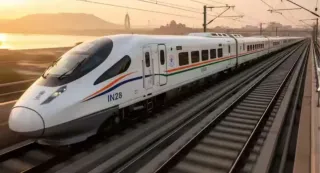
India is set to develop indigenous high-speed, or bullet, trains with a design speed of 350 kmph by 2030. The trains, known as B35, are expected to be comparable to Japan’s next-generation E10 series, which is also scheduled to enter production in 2030.
The development comes after the Union Cabinet approved the revised cost of the Mumbai-Ahmedabad High-Speed Rail (MAHSR) project, taking the total expenditure to more than Rs 2 lakh crore. The revised estimate is nearly twice the original cost projected in 2015. Around Rs 1 lakh crore of the revised expenditure will be funded through the Union Budget.
B35 Train Development Underway
The Railway Ministry informed the Cabinet that work on developing the B35 high-speed trains has already begun. The move follows Japan’s decision in December 2024 to gradually phase out production of its existing E5 series trains.
ALSO READ: India’s First Bullet Train: When Will Mumbai-Ahmedabad Service Begin Operations? Check Full Timeline
Japan has indicated that production of the E10 series will begin in 2030, with the trains expected to be ready for commercial operations by 2034. Indian officials said the possibility of operating E10 trains on the Mumbai-Ahmedabad corridor would be considered once they become available.
India To Develop Indigenous Train Control System
The ministry said manufacturing of the indigenous B28 high-speed trains has also started. Alongside the trains, India plans to develop its own Bharat Train Control System (BTCS), which will manage train speeds, distances between trains and safety operations on high-speed and conventional railway networks.
The system is being developed along similar lines to China’s Train Control System (CTCS).
Why Has The Project Cost Increased?
The revised cost of the Mumbai-Ahmedabad high-speed rail project has risen substantially from the earlier estimate of around Rs 1.1 lakh crore. According to the Railway Ministry, the increase is mainly due to:
- Land acquisition costs rising more than threefold to around Rs 19,700 crore.
- Infrastructure expenditure increasing by nearly 50 per cent to more than Rs 1 lakh crore.
- Expenditure on trains and signalling systems almost doubling compared with the 2015 estimates.
B28 Trains To Operate Initially
The current project cost, excluding the future Japanese E10 trains, works out to around Rs 399 crore per kilometre. The Mumbai-Ahmedabad corridor will initially operate with B28 trains, which have a design speed of 280 kmph and a maximum operating speed of 249 kmph.
BEML has already received a contract to manufacture 32 B28 trains. Two prototype trains are expected to be ready for trial runs by the first quarter of 2027.
ALSO READ: Ahmedabad-Mumbai Bullet Train Cost Doubles To Rs 2.1 Lakh Cr; When Are Services Likely To Begin?
BEML also informed the BSE on Friday that it had secured a separate Rs 5,400-crore contract to manufacture 15 additional B28 trains.
The 508-km Mumbai-Ahmedabad High-Speed Rail corridor is targeted for completion by December 2030.