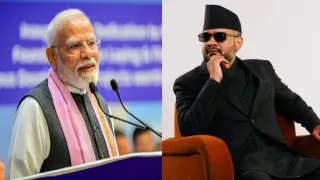
Jagran Correspondent, New Delhi | Nepal Prime Minister Balendra Shah on Sunday arrived in New Delhi for a two-day state visit to India, marking his first state visit to a neighbouring country since taking office. Jitin Prasada, Minister of State for Commerce and Industry welcomed Shah at the airport. His India visit is expected to put ties between the two neighbours on an upward trajectory, ending the cold phase that has prevailed since the regime change in Nepal.
Large Nepal Business Delegation Reaches New Delhi
Shah reached New Delhi on Sunday evening at the invitation of his Indian counterpart, Prime Minister Narendra Modi. Shah is leading a 34-member delegation that includes his Chief Advisor Kumar Byanjankar, Finance Minister Swarnim Wagle and Foreign Minister Shisir Khanal. A separate business delegation is also accompanying the prime minister's delegation to India.
Eyes On PM Modi-Shah Meeting
Prime Minister Narendra Modi and his Nepali counterpart Shah will hold a crucial bilateral meeting in an attempt to achieve a solution to the long-standing confusion in India-Nepal relations, especially after regime change in the neighbouring country.
Contentious Issues, Including Border Issue And Stalled Projects Likely To Be Discussed
The duo may also discuss some longstanding India-Nepal border disputes and stalled projects that began in the previous regime. However, the sources have dismissed reports that the issue of using Nepal's airports will be raised with Shah.
Vision Document To Cover 10 Broad Areas
A proposal for a shared vision document to give a new direction to India-Nepal relations is also under discussion. According to reports, the proposed vision document covers 10 broad areas of mutual cooperation. These include economic partnership, connectivity, investment, water resources and energy, digital connectivity, good governance, people-to-people contact, education, health, sports, and trade and transit.
Nepal's political instability has hampered the Indian government's efforts to establish a clear direction for its relations with this neighbouring country. Nepal has had several Prime Ministers in the past ten years. Previously, when former Prime Minister Pushpa Kamal Dahal visited India, the two countries announced several cooperation initiatives, but these initiatives were stalled due to Nepal's internal instability. The two leaders will virtually inaugurate several completed projects and lay the foundation stone for some new projects.
According to Foreign Ministry sources, the visit comes at a time when the two countries have strong convergence in national priorities on issues such as economic growth, social development, infrastructure expansion, technology adoption, and addressing natural disasters and climate change. The two leaders will comprehensively review bilateral relations and explore new dimensions of cooperation.
Focus On Stalled Projects
The announcements made during the Nepali PM's visit to India in 2023 will also be reviewed. They will also review announcements made during former PM Dahal's 2023 visit to India. This includes the Pancheshwar multipurpose project, the final location work for the Raxaul-Kathmandu railway link, and hydropower projects like the 669 MW Lower Arun and 480 MW Phukot-Karnali, where work has not progressed.
Despite the completion of surveys for the Raxaul-Kathmandu railway, no progress has been made due to political instability in Nepal. Similarly, the Pancheshwar project's DPR was agreed to be finalised within three months, but three years later, this work remains unfinished.
A significant portion of the 10,000 megawatt electricity export target remains unmet. Work on petroleum pipeline expansion and some integrated checkpoints has also slowed. Frequent regime changes in Nepal have been a major obstacle to the direction of relations between the two countries.
(With Inputs from Jaiprakash Ranjan/PTI)