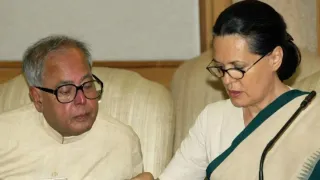
Following the release of Congress Parliamentary Party (CPP) Chairperson Sonia Gandhi's memoir, Belonging: A Journey of Love, a political controversy has emerged over a revelation about former Prime Minister Pranab Mukherjee. In her book, Sonia Gandhi recalls how Mukherjee once hinted at his desire to become prime minister during the UPA years. The memoir also mentioned times when Mukherjee lost his temper, “becoming almost purple in the face”.
The revelation has sparked a fresh political debate, with Mukherjee's daughter, Sharmistha Mukherjee, questioning why her father's ambition should have "shocked" the former Congress president.
Sharmistha reacted to Sonia Gandhi's account of her interaction with Mukherjee in 2010, in which she described him as someone who never gave up his ambition for the top post.
Sharmistha questioned why her father's desire to become prime minister should come as a surprise. She said his ambition was backed by decades of political and administrative experience, hard work and intellectual ability.
In a post on X, she asked, "What's there to get 'shocked' about? Is it a crime to be ambitious, especially when that 'ambition' was supported by decades of experience in politics & governance, hard work & a brilliant mind? Once, when asked by me whether he wanted to become PM, he very candidly answered that 'any politician worth his salt has this ambition."
She said her father came from a humble background and achieved everything in life through merit and hard work. She also pointed out that he was never handed important positions because of family connections or political privilege.
"My father came from a very humble background. Whatever he achieved in his life was through sheer merit & hard work. There was no one to serve him positions, including PM-ship, on a platter due to dynastic entitlements. If a well-deserving person harbours ambition to become prime minister, what's wrong with that, unless Sonia ji was 'shocked' by the fact that anyone outside the Gandhi-Nehru family could even dare to nurture such an ambition & furthermore dared to 'hint' it to her?" she said.
Sharmistha also responded to Sonia Gandhi's observation that she felt Mukherjee "never held it against me". She said her father did not hold any resentment towards Sonia Gandhi or anyone else over the matter.
"In this same context, I read that she said she felt 'he never held it against me'. From what I read in his diaries & whatever conversation he had with me, I would like to reassure her that he DID NOT hold it against her or anyone else. He was a pragmatic person with deep understanding. He understood her reasons & insecurities that all human beings are prone to," she added.
ALSO READ: BJP Calls Sonia Gandhi's Memoir An Attempt To 'Whitewash Congress' Historical Wrongs'
Her response has brought the debate over dynasty and political experience within the Congress back into focus. While Sonia Gandhi's memoir was expected to offer insights into the party's internal affairs, this particular revelation has added a new political angle to the discussion.
The Big Reveal: The 2010 Conversation
According to Sonia Gandhi's memoir, the incident took place in 2010, during the second UPA government. At the time, Manmohan Singh was Prime Minister, while Sonia Gandhi was the Congress president.
A weekly Core Group meeting was held to maintain coordination between the Congress and the government. The members included Pranab Mukherjee, Arjun Singh, AK Antony, Dr. Manmohan Singh and Ahmed Patel.
Gandhi writes that Mukherjee would often stay back after these meetings to have informal, one-on-one discussions with her. During one such meeting, Mukherjee spoke about his "serious differences" with the then Finance Minister, P Chidambaram.
After expressing his frustration, he made a remark that, according to Gandhi, left her stunned.
"He (Pranab) had developed serious differences with the Finance Minister, P. Chidambaram, and on one occasion, in 2010, I think after expressing his frustration, he shocked me with the suggestion that perhaps it was time for a change at the top, which I understood as a hint of his long-held desire to become prime minister," she wrote in her memoir.
Gandhi said she chose not to discuss the suggestion further.
"I gently changed the subject, and though he may have been disappointed, he never made me feel he held it against me," she said.
She also mentioned that Mukherjee could sometimes be short-tempered and would occasionally become "almost purple in the face".
Gandhi further recalled that the Congress had nominated Mukherjee as the UPA's presidential candidate in 2012. He went on to win the election and become the President of India.
"Our party did nominate him in 2012 as the UPA candidate for president, the highest office in our republic, and he was elected. I often called on him, mostly just to converse with the erudite and knowledgeable politician that he always remained, she wrote.
Gandhi also recalled that Mukherjee had left the Congress in 1984 and formed his own party after Rajiv Gandhi became Prime Minister. According to her, Mukherjee felt that he had been overlooked for the top post.
He returned to the Congress in 1989 but, as Gandhi writes, never gave up his ambition to become prime minister.
"Over the years he held virtually all the important portfolios in previous Congress governments, but deep down he felt his seniority and experience made him a natural candidate for the prime ministership," she wrote.
She recalls Mukherjee as an exceptionally knowledgeable and experienced political colleague, while also revealing his unfulfilled ambition to become the prime minister.
The 2010 conversation remained private for 16 years. Its revelation now offers a glimpse into the internal workings of the Congress and the UPA government, including the differences, ambitions and political equations among its senior leaders.
What Is Sonia Gandhi's 'Belonging: A Journey of Love' Memoir About?
In her memoir titled, Belonging: A Journey of Love, Sonia Gandhi writes about her childhood in Italy, her meeting with Rajiv Gandhi at Cambridge, and her family and political life in India.
The book recalls the personal losses that shaped her life in India, including the assassinations of Indira Gandhi and Rajiv Gandhi. The book also covers the events leading up to the assassinations of Indira Gandhi and Rajiv Gandhi.
It further discusses the discussions within the Congress after the UPA's victory in 2004, when Sonia Gandhi decided not to take up the Prime Minister's post. She also writes about her conversations with Congress leaders and her last conversation with her son, Rahul Gandhi.
Sonia Gandhi also shares stories from her early days as a daughter-in-law in the Gandhi family. She recalls some lesser-known incidents about former Prime Minister Indira Gandhi, including her anger, strictness and discipline.