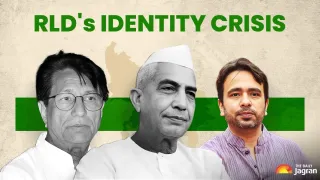
The Rashtriya Lok Dal (RLD) was once a strong political force in western Uttar Pradesh. The party was built on the legacy of former Prime Minister Chaudhary Charan Singh and his farmer-focused politics. For decades, it enjoyed strong support from Jats and farmers.
However, the RLD is now facing an identity crisis. Its shift to the BJP-led National Democratic Alliance (NDA) may have upset its traditional voters, created internal friction, and drawn criticism from its former allies.
Changing caste equations and the weakening of its traditional support base have further hurt the party.
From losing its strongholds in the 2014 Lok Sabha elections to winning seats in the 2022 Uttar Pradesh Assembly elections in alliance with the Samajwadi Party (SP), the RLD's journey shows its growing dependence on bigger parties. Now aligned with the NDA, the party faces another test as Uttar Pradesh prepares for the 2027 Assembly elections.
Let's explore why the RLD could not become an independent force in UP.
RLD's Formation and Early Years of Dominance
The RLD's political roots can be traced to former Prime Minister Chaudhary Charan Singh, who emerged as one of the most influential farmer leaders in northern India. His politics focused on farmers, agricultural issues and the interests of rural communities, particularly in western Uttar Pradesh. Over the years, he built a strong support base among Jats and other farming communities, making the region his political stronghold.
However, the Rashtriya Lok Dal was formally established by his son, Chaudhary Ajit Singh, in 1996-97. Ajit Singh carried forward his father's political legacy and sought to consolidate the farmer vote under the party's banner.
ALSO READ: Congress Wants 181 Seats, SP Wants Amethi-Rae Bareli: Inside High-Stakes Seat-Sharing Talks
The RLD initially enjoyed considerable influence in western UP, particularly in areas such as Baghpat, Muzaffarnagar and Meerut. Its support among Jats, along with its ability to attract Muslim voters in several constituencies, made it an important political player.
The party also benefited from its alliances with larger political formations. In the 2002 Uttar Pradesh Assembly elections, it contested 38 seats in alliance with the BJP and won 14. In the 2009 Lok Sabha elections, it again joined hands with the BJP and won five seats, its best performance in a parliamentary election.
Turning Point After 2014
The 2014 Lok Sabha elections marked a major turning point for the RLD. The party contested eight seats in alliance with the Congress but failed to win even one. The party founder Ajit Singh lost Baghpat, a constituency he had represented for several years. His son Jayant Chaudhary also lost from Mathura.
The setback continued in the 2017 Uttar Pradesh Assembly elections, when the RLD contested independently and managed to win just one of the 277 seats it contested.
ALSO READ: Bulldozers, Hindutva, Welfare: Will Yogi Model Work For BJP In UP Again? Analysis
In the 2019 Lok Sabha elections, the party joined hands with the SP and the Bahujan Samaj Party (BSP) but failed to win any of the three seats it contested. Both Ajit Singh and Jayant Chaudhary lost their respective constituencies.
The 2022 Assembly elections offered some relief, with the RLD winning eight of the 33 seats it contested as part of its alliance with the SP. However, this performance also highlighted the party's dependence on an alliance to remain electorally relevant.
BJP's Rise, Muzaffarnagar Riots
One of the biggest reasons behind the RLD's decline has been the BJP's growing influence in western Uttar Pradesh. Under Prime Minister Narendra Modi, the BJP successfully expanded its support among Jats and other communities that had traditionally backed the RLD. The party also benefited from a broader consolidation of Hindu voters.
The 2013 Muzaffarnagar riots further damaged the RLD's traditional support base. The violence deepened divisions between Jats and Muslims, two communities whose political support had played an important role in the party's electoral success. With the breakdown of this social alliance, the RLD found it increasingly difficult to retain its earlier influence.
The BJP benefited from these changing equations and strengthened its position in the region. Ajit Singh's defeat in the 2014 elections reflected how dramatically the political landscape had changed.
Another challenge has been the party's dependence on the political legacy of one family. After Charan Singh, Ajit Singh led the party, followed by his son Jayant Chaudhary. While Jayant has attempted to rebuild the organisation and connect with farmers and young voters, the party has struggled to expand its influence beyond its traditional seats. Its limited organisational reach and dependence on family leadership have also raised questions about its ability to grow independently.
ALSO READ: Why Bundelkhand Matters In UP Polls 2027: Inside BJP's Rise Across 19 Seats
Experiments With Different Alliances: From SP to BJP
The RLD's political journey has been marked by frequent changes in alliances, reflecting its struggle to maintain electoral relevance.
Over the years, the party has partnered with the BJP, Congress and SP. It has also been part of different political governments at the Centre and in Uttar Pradesh.
Ahead of the 2022 Assembly elections, Jayant Chaudhary joined hands with Akhilesh Yadav's SP. The alliance helped the RLD regain some of its lost ground in western UP. It won eight seats and secured nearly 2.9 per cent of the total votes in the state.
However, in February 2024, Jayant Chaudhary announced the party's decision to leave the Opposition's INDIA bloc and join the BJP-led NDA. The move came shortly after the Centre announced the Bharat Ratna for Chaudhary Charan Singh.
The alliance proved electorally beneficial. In the 2024 Lok Sabha elections, the RLD contested two seats in Uttar Pradesh, Baghpat and Bijnor, and won both.
The shift also strengthened the BJP's position in western UP by bringing a party with an established Jat support base into its alliance. For the RLD, the alliance offered political relevance, representation and an opportunity to retain its influence in its traditional strongholds.
What To Expect In The 2027 UP Polls
With the 2027 Uttar Pradesh Assembly elections approaching, the RLD's biggest challenge will be to prove that it can retain its support base while remaining part of the BJP-led NDA.
The party will seek to consolidate its influence among Jats, farmers and other rural communities in western UP. Jayant Chaudhary's position in the Union government could also help the party highlight issues concerning farmers, sugarcane prices and pending dues.