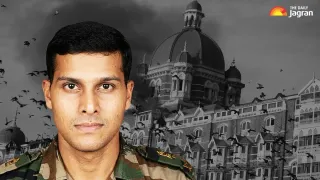
18 years ago, on November 26, 2008, the sudden terrorist attacks at crowded places in Mumbai, including Chhatrapati Shivaji Terminus, the Oberoi Trident, Nariman House, and the Taj Mahal Palace Hotel, brought the city to a standstill. For nearly 60 hours, the city fought the terrorists with utmost bravery. Although several innocent lives were lost, the city refused to break and showed the world what true resilience is.
From a brave National Security Guard commando to a Mumbai Police sub-inspector, the resolute security personnel put their lives in the line of fire to save the country. Among those who entered the burning Taj Hotel to take on the terrorists was Major Sandeep Unnikrishnan of the National Security Guard (NSG). His operation during the 26/11 attack became one of the most defining stories of courage and valour in history.
How Major Sandeep Unnikrishnan Took On Terrorists?
Major Sandeep Unnikrishnan served in the 51 Special Action Group (51 SAG) of the National Security Guard (NSG). He upheld the Indian Army's motto — service before self - while engaging with the terrorists inside the Taj Hotel. With a group of 10 commandos, he entered the hotel and managed to clear the room while engaging with the attackers in a firefight.
During the operation, Sunil Yadav, a fellow commander, was seriously injured. Major Sandeep helped him to evacuate the hotel and get medical help. Instead of retreating from the hotel, Unnikrishnan came back to the hotel and continued the operation. "Do not come up, I will handle them," were probably his last words that remained synonyms with his courage.
He was shot in the back by the terrorists and eventually succumbed to his injuries. The government later awarded him the Ashoka Chakra, posthumously, for his bravery on January 26, 2009.
"He Was Bold, Upfront, And Wanted To Be In Control"
Major Sandeep Unnikrishnan was born on March 15, 1977, in Kozhikode, Kerala. He completed his schooling at Frank Anthony Public School in Bengaluru. His classmate Sandeep Naidu, who spent nearly a decade with him, recalled Unnikrishnan and said, "He was bold, upfront, and wanted to be in control. He had so much conviction but was never pompous. He made up his mind to join the army when he was in class eight," as quoted by Hindustan Times.
Rejected By The Navy, Forged in Kargil
Major Sandeep Unnikrishnan was determined to join the armed forces from an early age. He cleared the UPSC defence entrance exam in 1995 and travelled from Bengaluru to Bhopal for his selection. However, a minor vision defect caused him to fail the Indian Navy medical tests. Instead, he accepted the offer from the Indian Army.
Unnikrishnan trained at the National Defence Academy (NDA) in Pune (94th Course) and the Indian Military Academy (IMA) in Dehradun (104th Course). After completing the training, he was commissioned as a Lieutenant into the 7th Battalion of the Bihar Regiment (7 Bihar) in June 1999. He was immediately deployed to the forward posts in the Kargil War (Operation Vijay), where he led small teams under heavy enemy fire.
Excelling in the demanding Ghatak commando course, Major Sandeep volunteered for the National Security Guard (NSG). Following his rigorous training, in January 2007, he was inducted into the 51 Special Action Group, the NSG's elite counter-terror unit. During the Mumbai attacks, he was entrusted to lead the 51 Special Action Group team deployed at the site.
The Horrors Of 26/11
The Mumbai terror attack happened on the night of November 26, 2008, when ten heavily armed terrorists belonging to Pakistan-backed Lashkar-e-Taiba entered Mumbai through the sea route. The attackers targeted prominent landmarks across the city, including Chhatrapati Shivaji Terminus, the Oberoi Trident, Nariman House, and the Taj Mahal Palace Hotel. 166 innocent lives were lost, and several buildings turned into battlegrounds.
The attack continued for nearly three days, eventually ending on November 29, 2008. Nine of the ten terrorists were killed during the security operation, while Ajmal Kasab was captured alive. After years of trials and tribulations, Kasab was sentenced to death in May 2010 and was hanged at Yerawada Central Jail in Pune on November 21, 2012.
As we mark another anniversary of the Mumbai 26/11 terror attack, we pause and salute the indomitable spirit of our people and security personnel who laid their lives to protect the city.