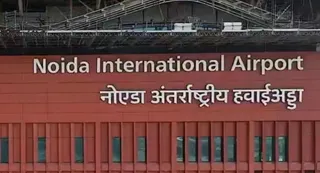
Prime Minister Narendra Modi is set to inaugurate the Noida International Airport, the first phase of which is operational, with a runway, terminal building, air traffic control (ATC) tower, cargo operations hub, and other related infrastructure, on Saturday in Jewar. This first phase will eventually become a significant multi-modal international aviation facility.
The Noida International Airport is predicted to be the largest aviation facility in India, developing into a five-runway capacity; its construction will relieve congestion on India’s Indira Gandhi International Airport and make it an alternative major global transit point, similar to what Dubai, Doha, and Abu Dhabi offer.
Noida International Airport (Image: X/@narendramodi)
ALSO READ: Noida International Airport Likely To Connect THESE Key Cities; Check List
Development of the facility is taking place through multiple phases, with an overall investment expectation of over Rs 36,000 crores. Phase One is expected to incur individual costs of Rs 11,077 crores for one runway and a passenger capacity of 1.2 crore people per year.
Jewar Airport's security screening area. (Image: X)
Anticipated passenger capacity for 2031 will be 3 crore as a result of constructing a second runway, increasing to 5 crore by 2036, and potentially reaching 7 crore by 2040 as additional expansion occurs.
Noida International Airport's terminal hall. (Image: X/narendramodi)
To support the current project, land acquisition is providing thousands of hectares; already, 3,300 acres have been acquired in Phase One of this project. Overall, the project will include greater than 5,400 hectares of land (with space for five runways and associated infrastructure).
Noida Airport's entry gate. (Image: X)
The project's role as a resource for aviation services combined with its impact on regional development creates an excellent opportunity for investment through the development of an aerocity, logistics parks and industrial clusters located in proximity to the airport and in coordination with the development.
Jewar Airport waiting area. (Image: X)
With its location next to major infrastructure corridors (eg, the Yamuna Expressway; the Delhi-Mumbai Expressway), connectivity is enhanced, and costs to transport goods are reduced.