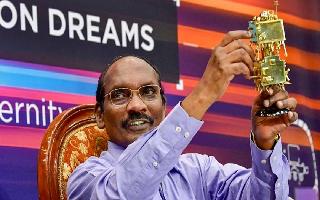
Bengaluru | Jagran News Desk: ISRO chief K Sivan has said that the space agency has not given the hope of establishing contact with lander Vikram and efforts to contact it will continue for the next 14 days.
Sivan has blamed the faulty execution in the last stage of the operation for the loss of communication.
“The last portion was not executed the right way, in that phase only we lost the link with the Lander, and could not establish communication subsequently. Right now the communication is lost. We will try to establish a link for the next 14 days,” Sivan said in an interview to Doordarshan.
“Vikram lander's descent went as planned and normal performance was observed up to an altitude of 2.1 km. Subsequently, the communication from the lander to the ground station was lost. The data is being analysed,” Sivan had said in the early hours on Saturday after the lander Vikram lost contact with the ground station.
Talking about Prime Minister Narendra Modi's address to scientists, Sivan said that he is a source of inspiration and support.
“His speech gave us motivation. In his speech, the special phrase that I noted was, 'Science should not be looked for results, but for experiments and experiments will lead to results',” he said.
The ground station lost contact with the Lander minutes before its touchdown on the Moon's South Pole early on Saturday.
Since the Chandrayaan-2's Orbiter, which is already in the intended orbit around the Moon, has extra fuel in it right now, its life is estimated to be 7.5 years, said Sivan.
In Pics | After Vikram setback, PM Modi’s encouraging words rejuvenate ISRO’s broken hopes
According to a statement issued by the agency earlier today, the Orbiter will send high-resolution images and enrich the understanding of Moon's evolution, mapping of minerals and water in its polar region.
Chandrayaan-2 was launched from the Satish Dhawan Space Centre in Sriharikota on July 22. After revolving around the earth's orbit, the spacecraft began its journey to the moon on August 14 and all manoeuvres were carried out to perfection until the last few minutes of descent.
(With agency inputs)