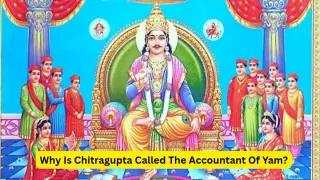
Lord Chitragupta is called the 'Accountant of Yama' because he maintains the Agrasandhani, a ledger that records every thought, word, and action of every living being.
When a soul dies, Chitragupta presents this karma record to Lord Yama (the god of death and justice), who decides whether the person deserves rebirth, heaven, or punishment in hell.
How Chitragupta Was Born?
Chitragupta is considered the 17th Manasaputra of Lord Brahma (god of creation). In the Yama Samhita, an extract from the 9th chapter of Ahilya Kamdhenu, a work of Hindu Law, Lord Yama complained to Lord Brahma that he was having difficulty keeping records of every individual.
So to help him, Lord Brahma meditated for 11000 years. When he opened his eyes, a figure emerged from his body with a pen and an inkpot. Because he was born from Brahma’s hidden mind, he was named Chitragupta and assigned as the supreme judge of karmic records.
He is also known as Kayastha, as he is believed to be born from kaya or the body, of Lord Brahma. Garuda Purana describes Chitragupta’s palace in Yamaloka as Kanchanabhavana, where he sits with 13 subsidiary deities to keep karmic data.
Chitragupta is considered the 17th Manasaputra of Lord Brahma (Image: Instagram/ttvaibhavam)
Why Chitragupta is Called the 'Accountant of Yama'?
Chitragupta isn't just someone who administers everything, but he is the ultimate cosmic auditor. He maintains a text called the Agrasandhani. This ledger records every virtuous act (charity, kindness, truthfulness), sins ( deceit, violence, greed) and intentions (why the action was conducted).
Unlike accounts made by humans that can make mistakes or can be bribed to change, Chitragupta’s record contains every little thing. The Garuda Purana states that not even a single negative thought escapes his record. He earned the title ‘Accountant of Yama’ because his ledger provides all the information to Lord Yama.
ALSO READ: Thumb, Index Or Ring Finger? Know Which Finger To Use For Tilak And What Each Represents
What Happens When A Soul Reaches Yamaloka?
According to Pretakhand of the Garuda Purana, when a soul leaves the human body, the messengers of death called the Yamdutas take the soul to Yamaloka (the realm of death).
Here the fate of the soul is decided. First, the soul is made to stand before Lord Yama’s throne. Then Chitragupta opens the Agrasandhani and reads every karma of the individual, good or bad. Then the elements (fire, air, sun, moon, water, mind) are called as witnesses to confirm the record.
Lord Yama then reviews Chitragupta's balance sheet. If the positive deeds are greater, then Lord Yama decide whether the soul deserves to go to heaven or a higher rebirth. If the negative deeds are more, then specific levels of hell are decided to cleanse its sins before reincarnation.
The soul is made to stand before Lord Yama’s throne (Image: Instagram/tattootemple108)
ALSO READ: Why Do Hindu Married Women Wear Toe Rings On Their Second Toe? Know The Belief Behind It
That is why Chitragupta is called the accountant of Yama because he keeps accurate records of every human being from birth to death.
FAQs
1. Is Chitragupta a God or a Deva?
Chitragupta is revered as a Hindu deity born directly from Lord Brahma. He is worshipped as the supreme deity of justice, truth, and literacy.
2. What is Chitragupta Puja?
Celebrated on the second day after Diwali, Chitragupta Puja is a festival where devotees, especially writers, accountants, and scholars, worship pens, inkpots, and account books, seeking wisdom, justice, and success.
3. What spiritual lessons can be learned from Chitragupta's legend?
Accountability, consequences of actions (karma), and ethical living are some spiritual lessons that can be learned from Chitragupta's legend.