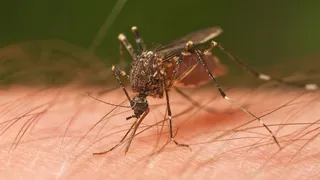
A recent study has found an interesting pattern on how mosquitoes decide where to fly and attack. The research notes that mosquitoes don't just randomly bite people, instead, a number of factors influence their blood-sucking habits. These small, flying insects, belonging to the order Diptera, use a combination of signs to locate and attack humans.
The study, published in Science Advances, was conducted by researchers from Georgia Tech and the Massachusetts Institute of Technology. They tracked hundreds of mosquitoes and analysed over 20 million data points to conclude their findings. The researchers used a mathematical model to note how female mosquitoes fly toward people to feed. The entire research majorly focused on female Aedes aegypti mosquitoes, also known as yellow fever mosquitoes.
What Did The Study Find?
Using 3D infrared cameras, the researchers observed how mosquitoes moved around objects using visual signals and carbon dioxide. In a controlled chamber, a human subject was kept and his clothing colours were changed. A recorder was placed to note the movement of mosquitoes that flew around that human. The study found that each mosquito responds independently to environmental cues. They do not gather but follow one another after noting the signals.
David Hu, a professor at Georgia Tech's George W Woodruff School of Mechanical Engineering and the School of Biological Science described the situation like a crowded bar, where everyone gathers for same things like drinks, music and ambience. "The same is true of mosquitoes. Rather than following the leader, the insect follows the signals and happens to arrive at the same spot as the others. They're good copies of each other," he said.
How Mosquitoes Find Humans To Bite?
Similarly, Christopher Zuo, who conducted the study as a Georgia Tech master's student stated that mosquitoes combine visual cues and carbon dioxide to determine their movement. "Previous studies had shown that visual cues and carbon dioxide attract mosquitoes. But we didn't know how they put those cues together to determine where to fly," he said. The study noted that dark colours and CO2 together create the strongest attraction for mosquitoes. Carbon Dioxide reportedly signals the presence of a living host to these flying insects.
ALSO READ: Not 'Homeward Bound', Viral Video Of Lost Dogs In China Has A Different Story To Tell