In an unexpected move, Hamas launched a coordinated attack on the Jewish holiday of Simchat Torah, catching Israelis off guard. The militant group fired thousands of rockets and dispatched dozens of fighters into Israeli towns near the Gaza Strip.
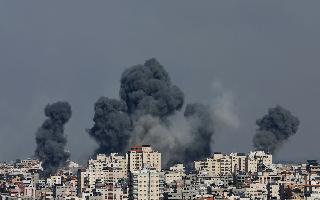
In response, Israel declared itself "at war" with Hamas and initiated airstrikes in Gaza, vowing to exact an "unprecedented price." Israeli Defence Forces (IDF) launched "Operation Swords of Iron" and targeted suspected Hamas hideouts within the Gaza Strip.
Israeli Prime Minister Benjamin Netanyahu said Israel's response to the Hamas incursion will "exact a huge price" on the militant group.
As the conflict escalated, casualties mounted, with over 300 people reported dead and another 2,000 injured in both Gaza and Israel. The Palestinian Health Ministry reported 232 deaths and 1,790 injuries in Gaza, while the Israeli Health Ministry reported over 100 fatalities and over 900 injuries in Israel.
Gaza's Hamas rulers launched attacks on Israel by land, air, and sea, catching the top brass of the Israel Defence Forces (IDF) and the country's political establishment off guard.
Millions of Israelis in the south awoke to the alarming sound of incoming rockets, with air raid sirens reaching as far north as Tel Aviv. Israel's anti-rocket interceptors were activated in Jerusalem.
Smoke rises after a rocket fired from the Gaza Strip hit a house in Ashkelon, southern Israel. (Image Source: AP Photo)
Hamas fighters breached Israel's highly fortified separation fence and entered Israeli communities along the Gaza frontier, creating panic among residents and engaging in firefights with Israeli soldiers.
Saturday's attack coincides precisely with 50 years and a day after Egyptian and Syrian forces launched an attack during the Jewish holiday of Yom Kippur, with the aim of reclaiming territory taken by Israel in a brief conflict in 1967.
Here is a timeline of how the Hamas attack unfolded in Israel:
At around 6:30 am (03:30 GMT), Hamas launched a barrage of rockets into southern Israel, triggering sirens in Tel Aviv and Beersheba.
Hamas claimed to have fired 5,000 rockets in their initial assault, while Israel's military estimated 2,500 rockets were launched.
"We announce the start of Operation Al-Aqsa Flood and we announce that the first strike, which targeted enemy positions, airports, and military fortifications, exceeded 5,000 missiles and shells," Mohammed Deif, head of the al-Qassam Brigades, the military wing of Hamas, said.
The rocket attack served as cover for a multi-pronged infiltration by fighters. Palestinian gunmen crossed into Israel around 7:40 am (04:40 GMT), primarily through breaches in security barriers between Gaza and Israel, as reported by Al Jazeera.
Fighters utilised various means, including a powered parachute and a motorboat, to infiltrate Israeli territory.
ALSO READ: Sikkim Flash Floods: MoS Ajay Mishra Meets CM Tamang, Assures Centre's Help; Rescue Ops Underway
Explosions were heard in Gaza around 9:45 am (06:45 GMT), and Israel's military spokesperson confirmed air attacks in Gaza at 10 am (07:00 GMT).
Israel's military said at 10 am (07:00 GMT), Palestinian fighters penetrated at least three military installations along the frontier: the Beit Hanoun border crossing (Erez), the Zikim base, and the Gaza division headquarters at Reim.
Israeli military vehicles were captured and driven into Gaza, while militants raided Israeli towns, including Sderot, Be'eri, and Ofakim.
Residents of southern Israel turned their homes into makeshift bomb shelters and panic rooms, heeding Israel's military orders to seek shelter.
Israeli troops continued to clear communities overrun by Hamas fighters till the late evening, with reports of gunmen taking hostages in Ofakim. Palestinian Islamic Jihad claimed to be holding Israeli soldiers, and videos circulated showing captives being taken into Gaza.
Israeli airstrikes persisted late into the night, along with rocket fire into southern Israel. Israeli troops remained engaged in clashes with Hamas gunmen at 22 locations near the Gaza Strip, highlighting the scale of the assault.