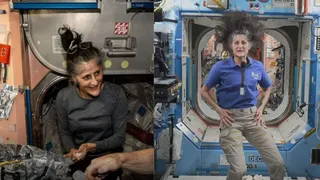
Indian-American astronaut Sunita Williams and her colleague Butch Wilmore have been stuck aboard the International Space Station (ISS) for over five months after their return to Earth was delayed due to problems with Boeing's Starliner spacecraft. While this extended stay was meant to be temporary, new safety issues aboard the ISS are raising alarms about the well-being of the astronauts onboard.
Although minor leaks have been an ongoing issue on the ISS for years, the situation has become more critical in recent months. NASA has confirmed that the number of cracks and leaks in the station has now reached over 50, heightening concerns about the safety of the astronauts living there. The damage to the station is so severe that the safety of the entire crew is no longer guaranteed.
A recently leaked NASA report revealed serious risks to the ISS, indicating that the station’s structural integrity may be compromised. This report has intensified fears that Sunita Williams and Butch Wilmore could be in danger if the cracks and leaks are not addressed soon.
What Went Wrong with the Boeing Starliner Mission?
Sunita Williams and Wilmore were supposed to return to Earth in September after a month-long stay on the ISS. However, the Boeing Starliner spacecraft that was meant to bring them home has experienced several glitches.
NASA initially planned the astronauts' return on June 13, but after multiple delays, the date was pushed back several times. The spacecraft's return to Earth was delayed from June 18 to June 26, and then further postponed as Boeing worked to fix the Starliner's mechanical issues.
Why Is the Starliner Mission So Important?
The Boeing Starliner mission is a critical part of NASA’s plans for maintaining a continuous human presence in space. The mission’s goal is to demonstrate the spacecraft’s ability to safely transport astronauts to and from the ISS, ensuring that NASA has multiple options for crew transportation, alongside Russia’s Soyuz spacecraft.
The Boeing Crew Flight Test is designed to demonstrate Starliner’s ability to conduct a six-month rotational mission to the ISS. "The flight test objectives were developed to support NASA’s certification process and gather the performance data needed to evaluate readiness ahead of long-duration flights," NASA stated.
With no clear timeline for their return, and the Boeing Starliner mission facing further delays, the safety of the crew and the integrity of the ISS itself are under increasing scrutiny. NASA is working tirelessly to resolve these issues, but the situation remains a critical challenge for space exploration.