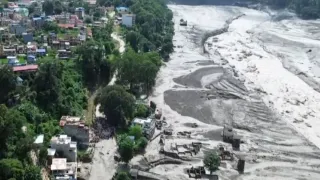
Nepal Flash Floods: Rescue and relief operations are underway in flood-hit areas of Nepal, with 3,253 people rescued so far. Amid rescue efforts, scientists and geologists are examining whether a glacial collapse and ice-rock avalanche triggered the devastating flash floods along the Bhote Koshi River on Wednesday. Preliminary assessments suggest that debris may have temporarily blocked the Lhende River, forming a landslide dam that later gave way and swept through Rasuwa district.
USGS Dismisses Earthquake Theory
Earlier on Thursday, the United States Geological Survey (USGS) had clarified that the tremors linked to the deadly flash floods in Nepal were caused by a glacial collapse and debris flow, not an earthquake. It was reported that around two-thirds of the glacier had broken away and fallen about 1.2 kilometres into the catchment area of the Lhende river.
Satellite analysis and scientific assessments further indicate that the collapse triggered a chain reaction, with falling ice carrying rocks, fresh snow and sediment, and temporarily blocking the river. This was followed by a powerful, debris-filled flood along the Bhote Koshi-Trishuli corridor.
ISRO Satellite Images Reveal Glacier Collapse
Satellite images examined by ISRO’s National Remote Sensing Centre (NRSC) showed that nearly two-thirds of the glacier had separated from its original position. A Sentinel-2 image from August 24 showed the glacier intact, while a Landsat-9 image taken on Wednesday after the disaster showed a large scar marking the area of the collapse. The images also showed a wide path of ice and rock avalanche descending towards the river.
Ice Mass Fell 1.2 Km From Around 5,200 Metres
University of Calgary geomorphologist Daniel Shugar, using Planet Labs imagery, estimated that around 200 square metres of ice at an altitude of about 5,200 metres broke away and fell nearly 1.2 kilometres vertically towards the valley floor. The fall converted gravitational energy into motion, causing the ice to break apart.
As the avalanche moved downhill, it grew larger, carrying rocks, sediment, trees and other material with it. Simon Cox, chief scientist at Earth Sciences New Zealand, said the collapsing glacier turned into a much larger debris flow as it picked up material along the way.
Debris Flow Behaved Like ‘Liquid Concrete’
According to experts, the sequence of events helps explain why the flood was very different from a normal rise in river levels. University of Texas at San Antonio hydrologist Hatim Sharif described the fast-moving mixture of mud and water as being similar to “liquid concrete.” The dense debris flow was powerful enough to carry away vehicles, structures and large rocks, rather than simply flowing around them.
ALSO READ: Kailash Mansarovar Yatra: Why Thousands Of People Choose The Rasuwa Route; Explained
You May Also Like To Watch: