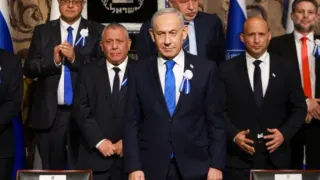
Israel Government Formation: Israel caretaker Prime Minister Benjamin Netanyahu is reportedly considering an unusual offer to Yashar Party leader Gadi Eisenkot as he moves closer to forming the next government. Reports suggest that he is set to propose a power-sharing arrangement in which Netanyahu himself would take the second position in a rotating prime ministerial government.
Netanyahu May Extend Rotation Offer
According to the Times of Israel report, Netanyahu is preparing to publicly signal his willingness to serve as the second prime minister under a rotation agreement with Eisenkot. However, the proposal has reportedly divided officials within his own inner circle. Channel 13, citing sources, reported that officials in the Prime Minister's Office have differing views on whether Netanyahu should make such an offer.
At the same time, Eisenkot remains doubtful about Netanyahu's intentions as he continues efforts to form a government before his mandate expires on December 6. He can also seek an additional 14 days from the president to complete negotiations. Yisrael Beytenu chairman Avigdor Liberman has also cautioned against taking Netanyahu's offer at face value.
In a post on X on Friday, he suggested that the proposal could be an attempt to delay the formation of an alternative government and force fresh elections at last. The developments come after Eisenkot secured coalition agreements with Yair Golan's Democrats and Avigdor Liberman's Yisrael Beytenu. He is also working towards an agreement with Naftali Bennett's B'Yachad party.
Eisenkot Accuses Likud Of Blocking Unity Talks
Meanwhile, Eisenkot affirmed that he remains committed to forming a government that would bring political change to Israel. He also accused Likud of failing to engage seriously in negotiations for a unity government. Eisenkot said both sides had held only five meetings over two weeks, despite repeated requests for more discussions.
"I have said all along that, for me, unity is an expression of shared values and a means of strengthening Israel, not a political arrangement for appearances or a tool for continuing to tear Israeli society apart from within," he wrote. Eisenkot also said his party was willing to make compromises on key issues, including judicial reform and the formation of a state commission of inquiry into the October 7 attacks, however, Likud didn't pay heed.
Numbers Remain A Major Challenge
Despite the progress in coalition bid, Eisenkot still faces challenges to prove the majority in the 120-member Knesset. His four-party bloc currently has 48 seats (including Together), short of the 61 needed for a parliamentary majority. He would need support from Arab-led parties, ultra-Orthodox parties or a combination of them to cross the majority mark. With Netanyahu considering a rotation arrangement and opposition parties negotiating their next steps, coming days will remain crucial to see who forms the next government in Israel.
You May Also Like To Watch: