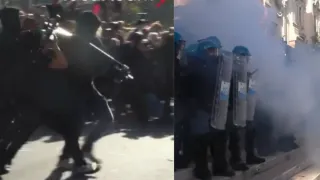
A student demonstration in Rome turned violent on Friday as protesters hurled paper bombs, firecrackers, glass bottles and other objects at Italy's Ministry of Education during a nationwide general strike that brought workers and students onto the streets across the country.
Demonstrators also threw helmets, a road sign and an electric scooter towards the ministry building on Viale Trastevere, where police were deployed to protect the premises. Students chanted slogans against Education Minister Giuseppe Valditara as tensions escalated.
VIDEO:
Footage from the scene showed two young men sitting on the ministry's steps while hooded demonstrators threw objects at police officers guarding the building. According to local media reports, the two students appeared to oppose the violence as the confrontation unfolded.
ALSO READ: Over 6,300 Italian Schools Receive Bomb Threats Through Identical Emails; PM Meloni Also Targeted
The clashes came amid a 24-hour general strike called by Italy's largest trade union, CGIL, alongside separate action by grassroots unions. Demonstrations took place in more than 100 cities, including Rome, Milan, Turin, Naples and Palermo. Student groups also organised protests in more than 45 cities.
Why Are Workers And Students Protesting Across Italy?
The strikes focused on pay freezes, the increase in the cost of living, education funding and issues of the government's expenditure. They called for pay increases, improved working conditions and increased investment in health, education and other public services.
Other issues in the mobilisation included the 2027 budget plan set out by Prime Minister Giorgia Meloni's government, which unions claim does not alleviate the economic burdens on households and workers.
Maurizio Landini, the head of CGIL, as quoted by Reuters, said more than one million people took part in protests in more than 100 cities. The mobilisation was an indication that the people wanted the government and politicians to hear their voices, he said.
Students, in the meantime, demanded greater investment in education institutions and universities, the implementation of plans to address the cost-of-living crisis and action to combat inequality.
Strike Disrupts Transport, Schools And Public Services
The 24-hour strike covered public and private sectors, including education, healthcare and local public transport. Bus, tram and metro services faced reductions or disruptions in several cities, while schools and some healthcare facilities were also affected.
Air and rail services were excluded from the CGIL's general strike, although a separate rail walkout was scheduled to begin on Friday evening and continue into Saturday. Planned air transport worker strikes for Friday were cancelled, while separate airport staff walkouts remained scheduled for Sunday at Milan and Venice airports.
Police were deployed across several cities to manage demonstrations and protect public buildings.
Student Protests Spread Across Europe
Italy's mobilisation was part of a broad youth mobilisation across Europe, with young workers and students protesting in a minimum of 25 countries, demanding well-funded education systems, affordable housing, quality public services, and measures to deal with the cost of living.
In Croatia, students went on strike and marched in about a dozen cities, calling for more spending on education, housing and public services rather than the military.
In Austria, several hundred people gathered outside the University of Vienna for a youth-led demonstration calling for increased education funding and lower military expenditure. Police dispersed the gathering following reported disturbances, using pepper spray and making several arrests.
In Germany, protesters were against a potential return to mandatory military service and demanded further investment in education.
The protests signalled deepening anxiety among the continent's youth about economic insecurity, public spending priorities and their opportunities to thrive.
You May Also Like To Watch: