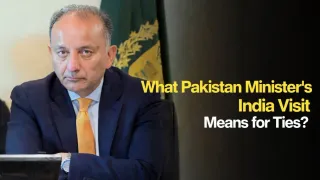
Pakistan Minister for Climate Change and Environmental Coordination, Musadik Malik, is in New Delhi to attend the first Shanghai Cooperation Organisation (SCO) Civilisational Dialogue Forum. His visit has drawn attention as it marks the first visit by a Pakistani minister to India in more than three years. At a time when relations between the two neighbours remain tense following the Pahalgam terror attack and the military conflict in May 2025, Malik has spoken about the need for dialogue, better understanding, and improved regional ties in his first visit to New Delhi.
A Visit That Has Drawn Attention
The Pakistani minister is leading his country's delegation at the three-day forum, which began on Friday and brings together representatives from different SCO member countries to discuss cultural and civilisational connections. Speaking to ANI after his arrival, Malik described the gathering as a "tremendous opportunity" for multilateral engagement. He also expressed hope that regular interaction between countries could help build trust and improve relations. His statements have, therefore, raised questions regarding whether this cultural outreach signals a potential thaw or resumption of bilateral talks between India and Pakistan.
'All Our Relationships Will Improve': Malik Express Hope
Malik spoke positively about the possibility of better relations across the region. When asked whether India-Pakistan ties could improve following the forum, he said, "I think all of our relationships will improve. The region is in flux, as you know. The plates underneath geopolitics are shifting very fast. I'm very hopeful that we will take a macro view."
Stand On Indus Waters Treaty
Despite expressing hope for better relations, Malik avoided discussing the Indus Waters Treaty in detail during his interactions at the forum. When asked about his earlier remarks on the treaty, he said the gathering was not the right place for bilateral discussions. "I have already stated and I reiterate that all our discussions here are taking place within a multilateral framework. Let us focus on that. This is not the appropriate forum for any kind of bilateral discussion."
However, India has made it clear that its position on the treaty remains unchanged. Responding to a question about Malik's visit and his earlier warning that Pakistan would 'cut off those hands' interfering with its share of Indus waters, MEA spokesperson Randhir Jaiswal said on Friday, "As far as the IWT is concerned, we have made our position very clear, and that is where it remains. There is absolutely no change."
Terrorism Remains A Major Point Of Disagreement
India has repeatedly linked any improvement in relations with Pakistan to an end to cross-border terrorism. As terrorism remains a major point of disagreement between the countries, when asked about the lack of action against terrorism in Pakistan, Malik said he did not want to turn a multilateral gathering into a platform for bilateral disagreements.
However, he maintained that both countries should present evidence and work towards a transparent mechanism to address terrorism. Meanwhile, India has consistently maintained that terrorism and talks cannot go together.
Regional Meetings, But No India-Pak Bilateral Talks
During his visit, Malik held meetings with Tajikistan's Culture Minister Sattoriyon Amonzoda, Mohammad Mahdi Imanipour, President of Iran's Islamic Culture and Relations Organisation and Minister of Culture of Azerbaijan, Adil Karimli. These meetings took place on the sidelines of the SCO forum. However, no details regarding his bilateral engagement with India have come to light, indicating that improvement in ties remain distant.
It should also be noted that there has been no formal bilateral meeting between the Prime Ministers of India and Pakistan in recent years. Prime Minister Narendra Modi and Pakistan Prime Minister Shehbaz Sharif have attended multilateral gatherings, including SCO summits, where they were present at the same venue, but have not held bilateral talks.
Prime Minister Narendra Modi was the last Indian PM to visit Pakistan, when he made an unscheduled stop in Lahore on December 25, 2015, to meet then Prime Minister Nawaz Sharif. Similarly, Sharif was the last Pakistani Prime Minister to visit India in 2014.
What Malik's Visit Means For India-Pakistan Ties?
Relations between the two countries had deteriorated sharply after the April 2025 Pahalgam terror attack, in which 26 people were killed. The fallout also affected diplomatic and economic ties as India put the IWT in abeyance and Pakistan suspended bilateral trade and reduced diplomatic representation.
In September this year, Indian and Pakistani warships also came into contact in the Arabian Sea, leading to accusations from both sides over notifications related to military exercises. Against this background, Malik's visit has offered an opportunity for interaction at a multilateral platform. However, it has not produced a diplomatic breakthrough.
While his positive remarks about dialogue and regional cooperation indicate Islamabad's willingness to keep communication channels open, India's response on the IWT and its position on terrorism show that major differences remain unresolved.
ALSO READ: Pakistan Minister Skates Over Question On Cross-Border Terrorism At SCO Dialogue | Watch
You May Also Like To Watch: