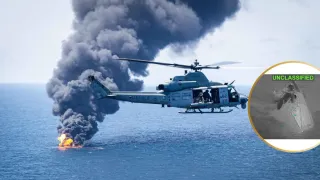
US Central Command has published video footage capturing an Iranian oil vessel consumed by flames before sinking into the Gulf of Oman, concurrently issuing a stern warning to Tehran that assaults targeting American naval assets will provoke severe economic consequences. The M/T Kylo constituted one of three crude oil carriers belonging to Iran that faced strikes executed by United States military units on Saturday (local time). This triggered fuel price speculations in India as it imports a major chunk of its crude oil through this route. India has already spiked oil and CNG prices, and a further choking of the route will jeopardise New Delhi's economy.
IRGC fired ballistic missiles aimed at US Navy
According to US Central Command, the action followed an initiative by Iran’s Islamic Revolutionary Guard Corps (IRGC) involving ballistic missiles aimed at two United States Navy vessels deployed within regional waters. Through a statement published on X, US Central Command identified the vessel as the M/T Kylo, noting, "Thanks to the precision and professionalism of American service members, the M/T Kylo sank in the Gulf of Oman today and joined Iran’s navy at the bottom of the sea."
American military officials confirmed that the strike operations took place on Saturday, local time, following the IRGC missile launch towards the two patrolling US Navy warships. Reports from US Central Command indicated that an American aircraft carrier alongside a guided-missile destroyer successfully avoided several incoming Iranian attacks, leaving zero American personnel wounded. Additionally, the United States military stated that operations had permanently disabled the M/T Downy close to Kharg Island alongside the M/T Stark 1 situated near Jask.
Officials added that the M/T Kylo, alternatively designated as the "Noxen", suffered destruction within the Gulf of Oman following strikes across multiple vital sections. US Central Command noted that crew members received orders to abandon the vessel prior to it becoming completely inoperable. US war secretary Pete Hegseth subsequently delivered a warning to Tehran, emphasising that Washington will direct strikes towards Iranian oil carriers should forces target United States Navy vessels.
"If Iran shoots at US ships, we will sink their oil tankers"
"It’s simple: if Iran shoots at US ships, we will destroy (and sink) their oil tankers. All they have to do is not shoot at @USNavy," Hegseth stated via a post on X. "Iran’s oil tanker fleet is defenceless — Iran has no navy or air force. Our planes, ships & subs can strike them all, in @centcom & @USPACOM," he added.
ALSO READ: Iran's Kharg Island Rocked By Explosions Amid Renewed Conflict With US; Oil Tanker Targeted
Furthermore, US Central Command explained that the trio of tankers formed segments of a multibillion-dollar shadow network financing the IRGC alongside associated regional proxy groups. Brad Cooper, commander of CENTCOM, remarked, "If you shoot at two of our ships, we will impose an even higher economic cost —taking out three of yours."
Iran calls US strikes a war crime
In response, the Iranian Foreign Ministry issued a strong condemnation of the military strikes, classifying the actions as breaches of the United Nations Charter while deeming them a war crime. "These illegal and irresponsible actions, which constitute a continuation of the US military aggression against Iran and are part of the naval blockade and economic warfare imposed on the Islamic Republic of Iran, represent a clear violation of Article 2(4) of the United Nations Charter, constitute a war crime, and pose a threat to international peace and security as well as maritime trade," the ministry said.
Impact on India
For India, the biggest concern is energy security. Any further disruption around the Strait of Hormuz could push crude prices sharply higher. Traffic through the strait has already fallen well below normal levels, increasing fears of supply shortages and higher shipping and insurance costs. India imports roughly 85-88 per cent of its crude oil, making it particularly exposed to global price shocks.
Higher crude prices could raise petrol, diesel, LPG and aviation costs, while also worsening inflation and widening India's import bill.
The immediate impact may be manageable because India has diversified supplies, including Russian crude, but a prolonged Hormuz disruption would significantly increase economic pressure.
(With inputs from ANI)
You may also like to watch