
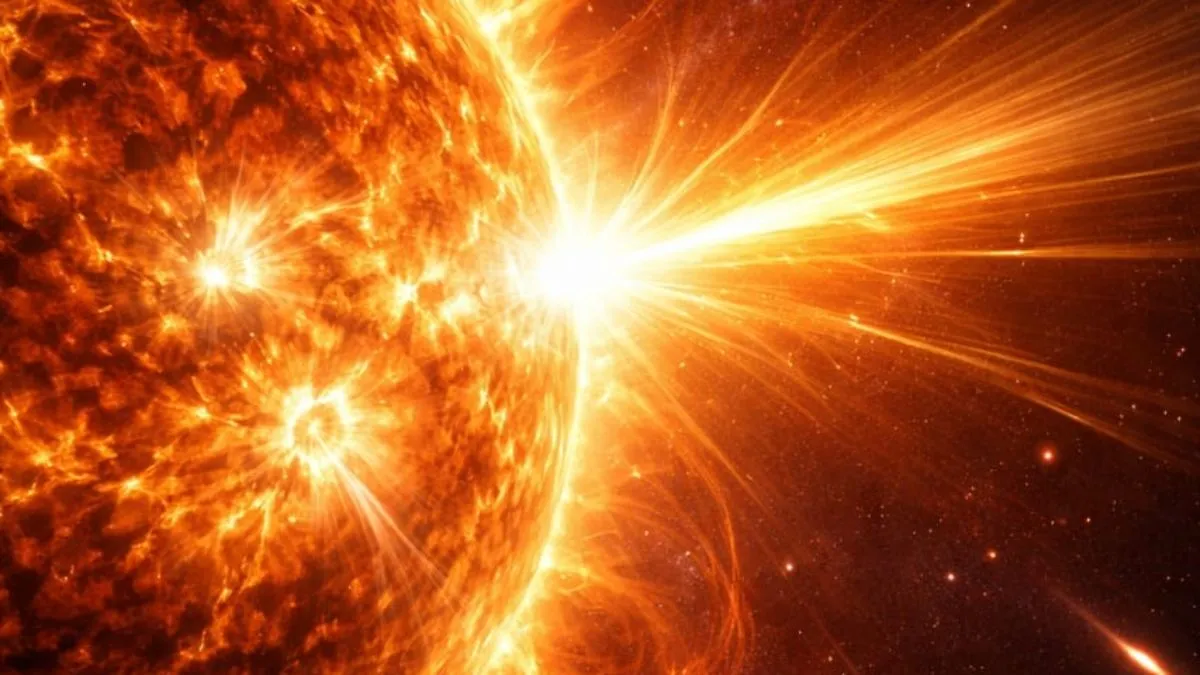
Our planet Earth just witnessed its largest and most powerful solar storm on Tuesday night. Live Science says that the Sun released a strong X-class solar flare, which has been recorded to be the largest in the past 23 years. The solar storm did disrupt a few things, but what came along with it are the popular and mesmerising northern lights, also known as the Aurora Borealis(Northern Lights) in the northern hemisphere and Aurora Australis(Southern Lights) in sourthen hemisphere. These auroras were seen in Greenland, Austria, Germany, California and more places in the southern hemesphere as well.
ALSO READ: Apple AI-Powered Siri Update: Tech Giant Preparing For Its Biggest Upgrade Yet, Suggests Report
Strongest Since 2003
Going by the reports on Space.com, the geomagnetic interference began on Monday, which resulted from a collision between Earth's stratosphere and a cloud of solar radiation. Its impact disrupted magnetic fields that are invisible to the human eye but surround the Earth. Due to this, charged particles from the radiation get a chance to get deep inside the atmosphere. According to NOAA's (National Oceanic and Atmospheric Administration) Space Weather Prediction Center, this storm surpassed the intensity of what is known as the 'Halloween space weather storms' in October of 2003, which were of high intensity as well.
How Do Solar Radiation Storms Occur?
These storms occur when charged particles, which consists of mainly protons, start to accelerate to extreme speeds due to powerful magnetic eruptions taking place on the sun, often involving coronal mass ejection(CME). These charged particles then reach up to speeds that are a significant fraction of the speed of light. Therefore, these particles can cross vast distances, approx. 150 million kilometres between the Sun and the Earth, in a few minutes, according to NOAA (National Oceanic and Atmospheric Administration). When these particles arrive, protons containing the most amount of energy go through Earth's magnetic defences and travel along with the invisible line of our planet's magnetic fields towards the poles, where they dip into the upper atmosphere. This is what sometimes causes the Northern Lights or Southern Lights to show up at the poles and nearby.
Recommended For You
There are different types of classifications of these solar storms; NOAA has classified them from S1 (minor) to S5 (extreme). The storm that Earth witnessed on January 19 was an S4-level storm, which is categorised as severe.

Image Credits: NOAA (National Oceanic And Atmospheric Administration)
Although it does sound a bit harsh and life-threatening, these storms pose no immediate threat to human life on the ground, all thanks to Earth's atmosphere, the thickness of which prevents such particles from entering the ground level, as it absorbs the radiation before it touches the surface. According to Space.com, space weather physicist Tamitha Skov has explained that the storm had a 'soft' particle spectrum, which basically means that these particles lacked the extreme energy needed to reach ground level.
Are There Any Risks?
Although there is no ground-level threat, things change as altitude increases.
These storms increase the risk of exposure to radiation for astronauts and for people travelling in the airlines and their crew, which are especially flying around the polar routes. These storms also affect satellites, as energy particles that interact with them can disrupt the functioning of electronics that are onboard, like sensors, etc. These sudden photon fluxes can also result in degrading spacecraft instruments.
ALSO READ: Did You Know About These Apple Watch Features? Walkie-Talkie, Camera Control And More
Solar Storm Witnessed Across The Planet
This was not an isolated incident, and it was witnessed by many across the globe. A few posts on X give us a glimpse of what was witnessed.
Took a break on our drive home from #SPNVegas and spotted the aurora from the southern California desert just after sunset! pic.twitter.com/iBNQ4Iidl6
— ❄️ Liz Madsen ❄️🎇🎆🎉🇺🇸🇺🇦 (@Paleonut_) January 20, 2026