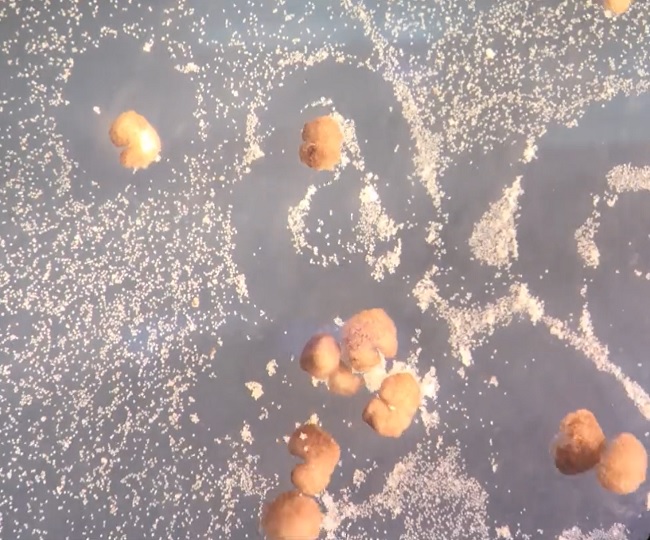
New Delhi | Jagran Trending Desk: In a first, Us Scientists from the University of Vermont, Tufts University, and the Wyss Institute for Biologically Inspired Engineering who created the world's first living Robots, 'Xenobots' has now claimed that the robots can reproduce now. They have created self-replicating robots in a way that is not seen in plants and animals reported CNN.
Now these, self-replicating robots can find single cells, gather hundreds of them together, and create their baby version inside their mouth. During the process, these embryonic cells would develop into the skin. Xenobots were first unveiled in the year 2020. Xenobots are sized less than a millimeter, created from the stem cells of the African clawed frog.
"I was astounded by it," said Michael Levin, a professor of biology and director of the Allen Discovery Center at Tufts University who was co-lead author of the new research reported CNN.
"People have thought for quite a long time that we've worked out all the ways that life can reproduce or replicate. But this is something that's never been observed before," says co-author Douglas Blackiston, Ph.D., the senior scientist at Tufts University.
Recommended For You
Our third xenobots paper was published today in PNAS.
— Sam Kriegman (@Kriegmerica) November 29, 2021
In a nutshell: they can now self-replicate.
w/ @DougBlackiston, @drmichaellevin, @DoctorJosh
More info: https://t.co/ySLBHeaGlL pic.twitter.com/vTvS2E3PoG
"Xenobots, which were initially sphere-shaped and made from around 3,000 cells, could replicate. But it happened rarely and only in specific circumstances. The Xenobots used "kinetic replication" -- a process that is known to occur at the molecular level but has never been observed before at the scale of whole cells or organisms," Josh Bongard of the University of Vermont, the lead author of the research said.
The scientists created Xenobots by scraping living stem cells from frog embryos. And, with the help of artificial intelligence, the researchers then tested billions of body shapes to make the Xenobots more effective at this type of replication. The supercomputer came up with a C-shape that resembled Pac-Man, the 1980s video game. They then left them to incubate. After this, the cells were cut and reshaped into specific "body forms."