
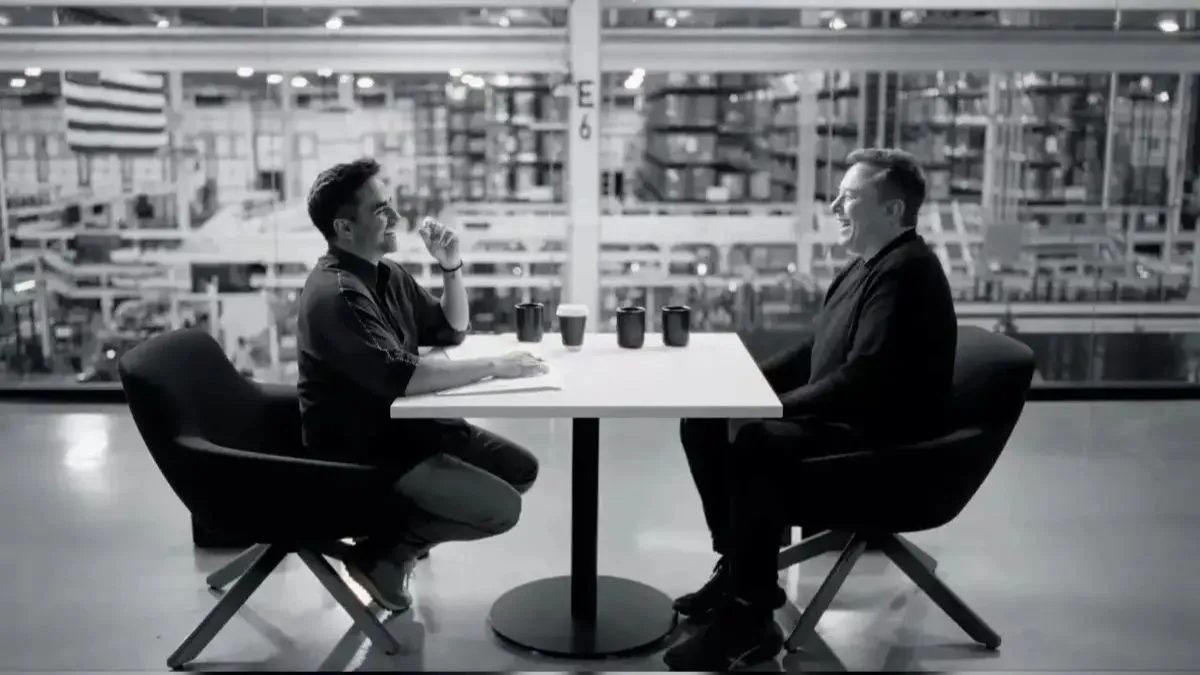
Tech billionaire Elon Musk has once again predicted a future where human labour becomes largely unnecessary, saying rapid progress in artificial intelligence and robotics will make “working optional” within the next decade or two. Speaking on Zerodha co-founder Nikhil Kamath’s People by WTF podcast, Musk said the world is “heading into an age of abundance” where machines will take over most productive tasks.
Musk's Bold Prediction On Kamath’s Podcast
During the conversation, Musk said he expects “in less than 20 years, working will be optional,” adding that the shift could come even faster. “Maybe even in 10 or 15 years,” he said. He compared future work to the choice between growing vegetables in a backyard or buying them from a store like matter of preference rather than necessity.
Musk explained that as AI systems and humanoid robots advance together, they will be capable of producing nearly everything people need. “If AI and robotics continue to advance, people will have any goods and services they want,” he said.
🇺🇸 ELON ON AI: “IN LESS THAN 20 YEARS, WORKING AT ALL WILL BE OPTIONAL”
— Mario Nawfal (@MarioNawfal) November 30, 2025
"I think it will actually be that people don’t have to work at all.
My prediction is less than 20 years.
Working at all will be optional, like a hobby, pretty much.
And that would be because of increased… https://t.co/plMPDUmHXB pic.twitter.com/y3l0mhjImw
Similar Remarks At Global Forums
This is not the first time the Tesla and SpaceX chief has made such claims. At the US–Saudi Arabia Investment Forum this year, he argued that automation could make money “irrelevant” and eradicate poverty. In several posts on X, including one responding to speculation about Amazon’s warehouse automation, Musk said AI and robots would “replace all jobs,” leaving work as a voluntary activity.
Musk’s prediction aligns with his earlier idea of a “universal high income,” which he described during a 2023 discussion with former UK Prime Minister Rishi Sunak. According to him, future societies would not rely on wages for sustenance because machines would produce everything at minimal cost. In such a scenario, he said, income would not come from redistribution but from the abundance created by AI systems.
Recommended For You
Global Trends Reflect Growing Automation
While Musk’s vision is ambitious, global labour trends show steady movement toward automation. A World Economic Forum report estimated that nearly a quarter of jobs will change significantly by 2027. McKinsey projected that up to 30 per cent of US work hours could be automated by 2030. Companies across sectors, from logistics to IT services, are already reducing hiring or restructuring operations due to efficiency gains from generative AI.
Despite global momentum, researchers say India is far from entering a work-optional era. Employment is deeply linked with social identity and economic stability. Millions depend on daily wages, and human labour continues to be more affordable than automation across large parts of the economy. But India may gradually move toward a hybrid future where AI handles routine tasks, easing workloads and creating more flexible job models. Full disengagement from work, though, remains distant.