

- AI use in education impacts students' critical thinking.
- Colleges reintroduce oral exams to counter AI cheating.
- Cornell, UPenn lead shift to in-person assessments.
From newsroom to classroom, every article and every answer now seems perfectly polished. But when questioned, both journalists and students often struggle to explain what they’ve written.
So why does every news story feel nearly flawless, and every homework assignment sound strikingly similar? The answer is obvious: widespread access to artificial intelligence (AI). It has made work easier, but not necessarily better.
What truly makes a difference is the human touch, a genuine connection with the audience. AI-generated language can feel mechanical, and an overload of fancy words only widens the gap, especially for regional readers.
A worrying trend of using AI among students
Educators are no longer naively wondering if students will use generative AI to do their homework for them. A big question now is how to determine what students are actually learning.
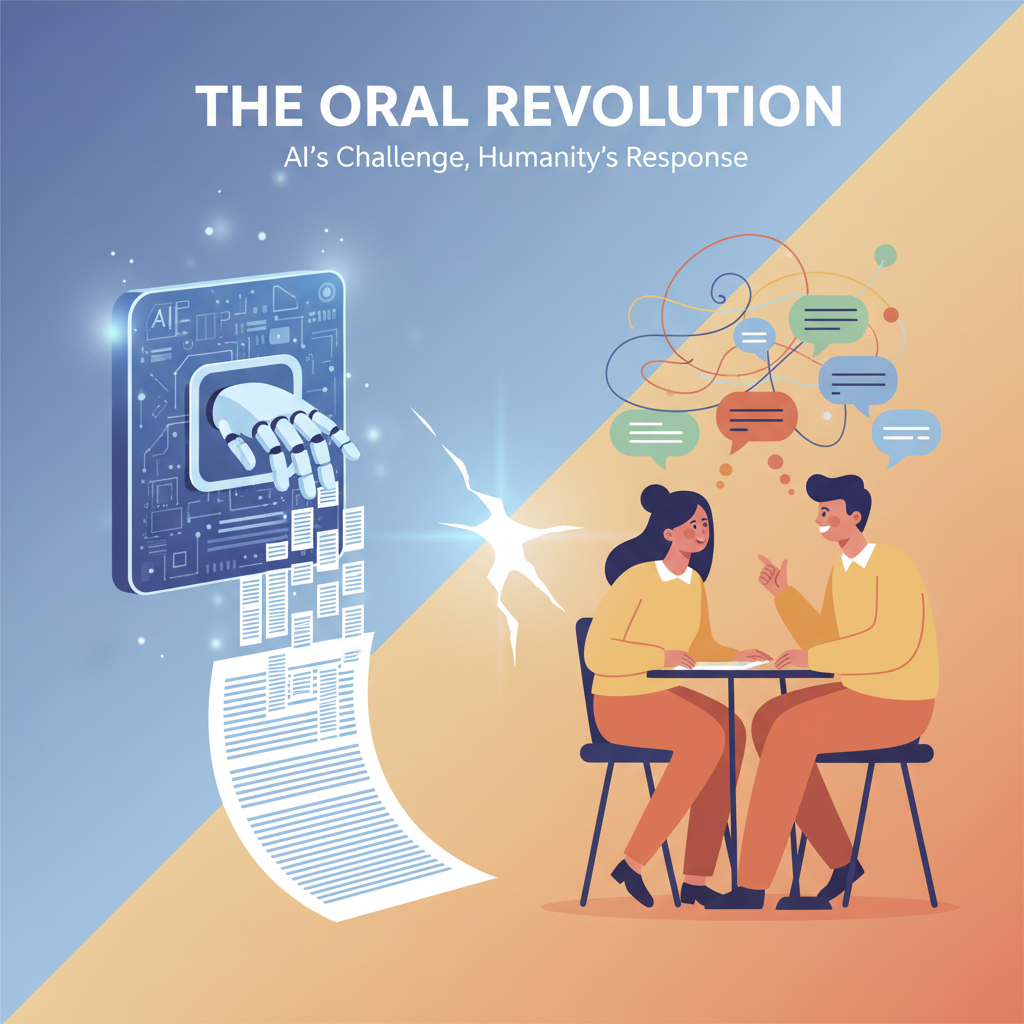
College instructors across the US are noticing troubling new trends as generative artificial intelligence becomes more sophisticated. Take-home essays and other written assignments are coming back perfect. But when students are asked to explain their work, they can’t. The long-term impact of AI use on critical thinking remains to be seen, but educators worry that students increasingly see the hard work of thinking as optional.
How are teachers tackling AI in colleges?
The assignment involves no laptop, no chatbot and no technology of any kind. In fact, there’s no pen or paper, either. Instead, students in Chris Schaffer’s biomedical engineering class at Cornell University are required to speak directly to an instructor in what he calls an “oral defence.”
It’s a testing method as old as Socrates and making a comeback in the AI age. A growing number of college professors say they are turning to oral exams and combining a variety of old-fashioned and cutting-edge techniques to help address a crisis in higher education.
“You won’t be able to AI your way through an oral exam,” says Schaffer, who introduced the oral defence last semester told news agency the Associated Press.
Some colleges shift toward in-person tests
At the University of Pennsylvania, Emily Hammer, an associate professor of Middle Eastern Languages and Cultures, now pairs oral exams with written papers in her seminar classes.
“It comes across as if we’re trying to prevent cheating,” Hammer says. “That’s not why we’re doing this. We’re doing this because students are actually losing skills, losing cognitive capacity and creativity.”
ALSO READ: Australian Man Uses AI, ChatGPT To Create Cancer Vaccine For His Dog; Here's How
Hammer forbids AI use on all writing assignments but tells her class she knows she can’t enforce that. However, if they haven’t written their papers themselves, defending the material face-to-face will likely be “a very stressful situation.”
Hammer’s class is part of “a massive shift toward in-person assessments,” both written and oral, at Penn, says Bruce Lenthall, executive director of the school’s Centre for Teaching and Learning. The Ivy League school is one of a small but growing number of universities that have started running faculty workshops on oral exams.
Rise of oral exams in US colleges
Oral exams are not traditionally part of the modern American undergraduate system, unlike certain European universities. For instance, in the Oxbridge tutorial system in England, students meet faculty for weekly discussions. Some U.S. colleges saw a move toward oral exams during the COVID-19 pandemic to address concerns about online cheating, and interest has intensified since the launch of ChatGPT in 2022.
ALSO READ: ChatGPT Adult Mode Delayed Again As OpenAI’s ‘Code Red’ Reportedly Comes To An End
During the pandemic, engineering professor Huihui Qi launched a three-year study at the University of California, San Diego on how to scale oral exams. Several universities have since invited her to provide faculty workshops or discuss her research.
(With inputs from agency)