
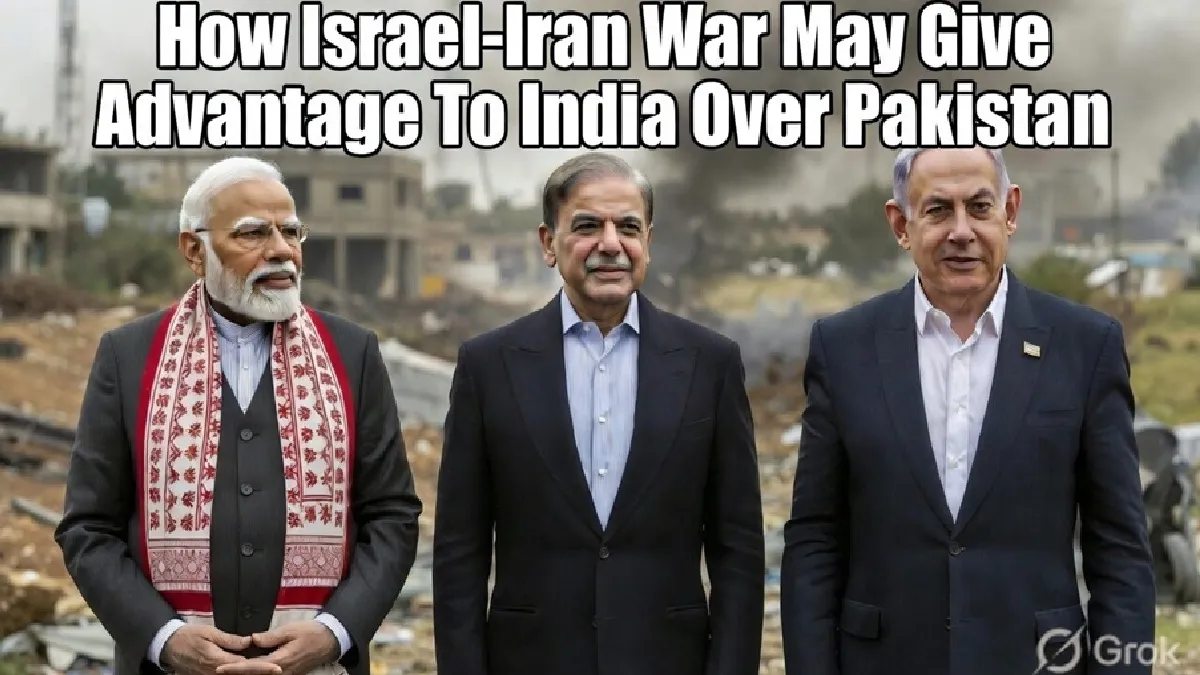
Israel-Iran War: The ongoing war in the Middle East has spiralling implications. It will also affect the geopolitics of South Asian region. As Israel and the US took advantage in armed conflict against Iran after killing the top leadership, including Supreme Leader Ayatollah Ali Khamenei, it is expected that post-war, the influence of Israel in Iran will increase, which will go in favour of India, while against Pakistan.
India's Foreign Policy Shifting
Under Prime Minister Narendra Modi's leadership, India solidified its ties with Israel and other Gulf countries. On Tuesday, PM Modi spoke to Sultan Haitham bin Tarik of Oman, Crown Prince of Kuwait Sheikh Sabah Al-Khaled Al-Hamad Al-Mubarak Al-Sabah and Amir of Qatar Sheikh Tamim bin Hamad Al Thani, whose countries were attacked by Iran. The prime minister also spoke to his Israeli counterpart, Benjamin Netanyahu. India has constantly expressed concern over the ongoing conflict in West Asia, asserting the need to find a diplomatic solution through dialogue.
Over the last two days, the prime minister has spoken to the leaders of eight West Asian countries in the wake of a coordinated offensive launched against Iran by the United States and Israel. In retaliation, Iran has fired drones and missiles at Israel and US military installations around the Gulf.
Recommended For You
Also, the Modi government remained silent on the Khamenei assassination, which shows a shift in foreign policy amid rapidly changing geopolitics.
Khawaja Asif Admits Israel's Influence May Trouble Pakistan
Defence Minister Khawaja Asif's statement on the Israel-Iran war suggests that if the present regime in Tehran loses, it will create trouble for Pakistan. He said the Zionists orchestrated the Iran war to expand Israel's influence on the border of Pakistan. "The joint single point agenda of Afghanistan, Iran, and India will then be enmity towards Pakistan, making our borders insecure, surrounding us with enemies from all sides, and turning Pakistan into a vassal state," he claimed in the statement.

Pakistan To Face Challenges From Three Directions
Pakistan shares borders with four countries - India to the east, Afghanistan to the northwest and north, Iran to the southwest, and China to the northeast. Except for China, Pakistan is surrounded by neighbours with whom its relations are strained. Israel's victory means India's friend country's influence on the Pakistan-Iran border, which is an advantage for New Delhi.
ALSO READ: Iran-Israel War: Trump Says 'Too Late' For Tehran Negotiations Talks As Middle East Tensions Soar
Pakistan-Afghanistan Conflict
India has tactfully improved its ties with the Taliban, once considered a terror group, to corner Pakistan if the situation demands. Currently, Pakistan is facing a stiff challenge from the Taliban as the neighbouring countries are engaged in armed conflicts in recent days. Here, too, India has an advantage as India recently condemned Pakistan's airstrikes in Afghanistan, which killed several civilians.
Pakistan, which continuously pushes terrorists into Indian territories through infiltration across the border, will have an adverse impact if a pro-Israel government take over Iran and on the contrary, it will go in favour of India.