
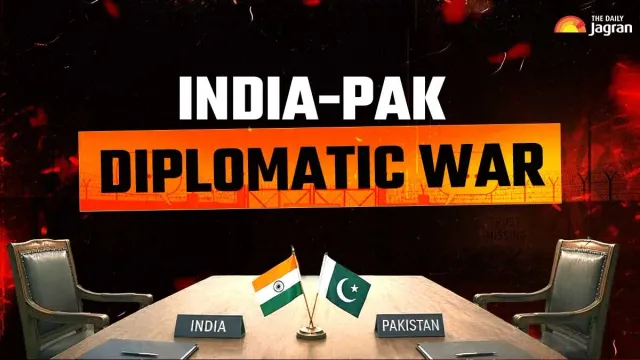
- India-Pakistan relations witness sharp diplomatic conflict escalation.
- Envoys summoned twice over naval collision and border incidents.
- Incidents highlight fragile ties, low threshold for confrontation.
New Delhi: In a major diplomatic conflict escalation, India-Pakistan relations have witnessed another sharp flare-up in their already strained ties, with the two countries summoning each other's envoys twice in the past one month. The first major episode came on September 16, after an Indian and Pakistani naval vessel collided in the Arabian Sea. New Delhi summoned Pakistan's Charge d'Affaires and lodged a strong protest, describing the conduct of Pakistani naval units as "unacceptable and unprofessional."
India also said the incident violated provisions of a 1991 bilateral agreement governing military movements.
Envoys summon
Pakistan subsequently summoned India's Charge d'Affaires and lodged its own protest, accusing India of provocative conduct. This was the first time when New Delhi lodged strong protest following the Pahalgam terror attack in Jammu and Kashmir. Before the terror attack last year, New Delhi had summoned temprory Pakistani envoy following reports of interrogation of two of its officials in its embassy in Islamabad.
The second confrontation came on Saturday, October 3, following the alleged deaths of two Pakistani nationals near the International Border in Punjab. Pakistan summoned India's Charge d'Affaires, describing the two men as unarmed civilians who had inadvertently crossed the border and demanding an investigation. India rejected that account, maintaining that the individuals were involved in an infiltration attempt and that BSF personnel acted after repeated warnings.
🔊PR No.2️⃣7️⃣2️⃣/2️⃣0️⃣2️⃣6️⃣ Indian Chargé d’Affaires Summoned Over Killing of Two Pakistani Civilians 🔗⬇️ https://t.co/7o9A1UvrLF
— Ministry of Foreign Affairs - Pakistan (@ForeignOfficePk) October 3, 2026
Subsequently, India summoned Pakistan's Charge d'Affaires and protested what it called the "continued facilitation" of illegal cross-border infiltration. New Delhi also linked the incident to what it described as a wider pattern involving cross-border movement by armed narcotics syndicates.
Why the diplomatic exchanges matter
The significance lies not simply in the number of summons but in the nature of the issues behind them. The September confrontation involved the two countries' militaries at sea, while the October episode involved armed border personnel and deaths along the International Border.
Such incidents carry a greater escalation risk because they involve forces operating directly against, or in close proximity to, one another. A relatively contained incident can therefore become a diplomatic confrontation when both governments publicly reject the other's version.
At the same time, the repeated summoning of diplomats also provides both sides with a formal channel to communicate grievances without immediately escalating to military action.
The exchanges show that India-Pakistan relations remain highly fragile, with little political trust and significant sensitivity around military and border incidents. The fact that both sides continue to maintain Charge d'Affaires-level diplomatic representation also reflects the limited nature of bilateral engagement.
Yet there is another important dimension. Despite the tensions, India has continued to participate in multilateral mechanisms involving Pakistan, including an SCO national coordinators' meeting in Islamabad last week.
Therefore, the latest diplomatic tit-for-tat does not necessarily indicate an imminent military confrontation. But it does demonstrate how low the threshold for diplomatic escalation has become- a naval collision in international waters and a border shooting were enough to trigger reciprocal protests within weeks.
The larger concern is not merely four diplomatic summons-- it is the growing frequency with which military and border incidents are becoming tests of India-Pakistan crisis management.
(With inputs from Dawn and PTI)