
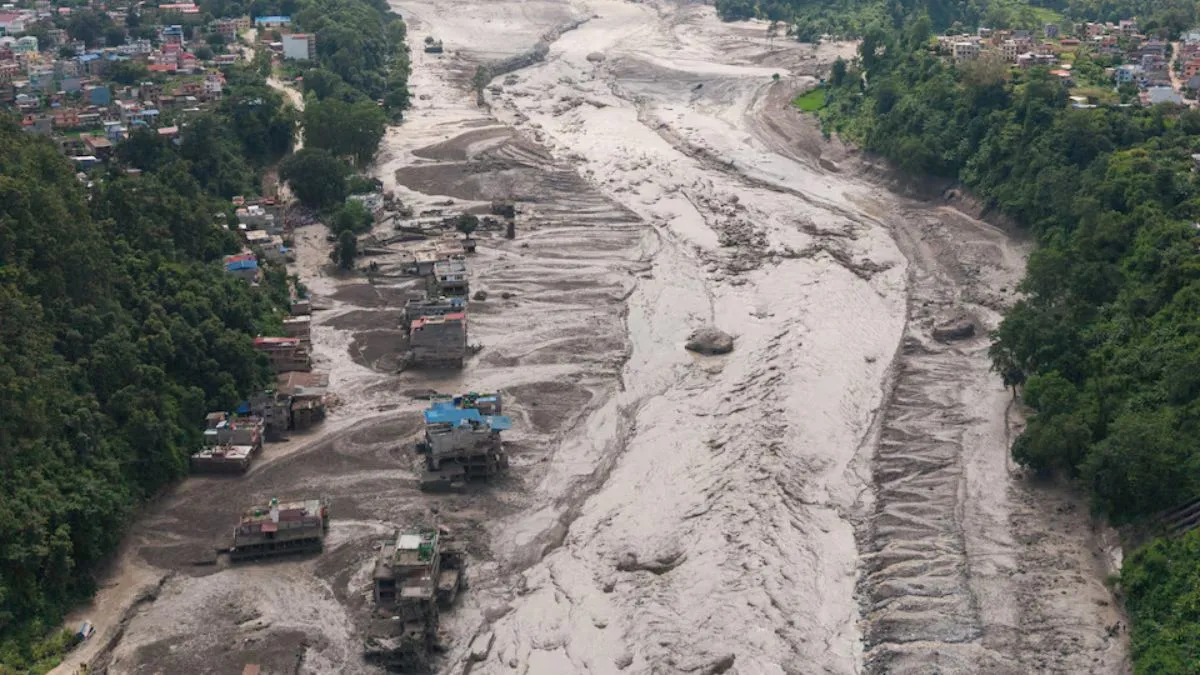
- Rasuwagadhi-Bhote Koshi valley trade route destroyed by flash floods.
- Vital Nepal-China economic corridor, 260 years old, now severed.
- Miteri Sanghu bridge washed away, impacting Chinese goods flow.
For more than 260 years, Rasuwagadhi and the Himalayan corridor through the Bhote Koshi valley served as one of Nepal’s most important trans-Himalayan trade routes. However, on Wednesday, a deveastating flash floods in Nepal ruined the economic corridor that served as major trade routes between the two neighbouring countries.
According to a report by Jagran, long before modern highways and trucks reached the region, mule caravans (Kachhars) carried rice and other grains from Nepal northwards to Gyirong, where traders exchanged them for Tibetan salt and wool. Salt was then transported south towards Nepal’s middle hills and India. Newar merchant communities also established themselves in Tibetan trading towns, making the corridor an important centre of commerce and cultural exchange.
A century old trade route
The route was not only economically significant but also strategically vital. The Gorkha kingdom captured Nuwakot in 1744, partly to gain control over the lucrative Tibet trade. Nepalese troops later used the same corridor during invasions of Tibet in 1788 and 1791. Chinese and Tibetan forces counter-attacked in 1792, highlighting the route’s military importance.
Recommended For You
In the 19th century, Jung Bahadur Rana built the Rasuwagadhi fort near the frontier while preparing for another invasion of Tibet in 1855. The 171-year-old fort continued to stand beside the modern Rasuwagadhi-Gyirong customs crossing, linking Nepal with China.
Major gateway for Chinese consumer goods
In recent years, Rasuwagadhi had taken on a very different role. It became a major gateway for Chinese consumer goods, including electronics, garments, footwear and electric vehicles. Nepal’s growing EV market made the crossing particularly busy. More than 6,500 Chinese electric cars, jeeps, vans and minibuses entered Nepal through Rasuwagadhi in 2025-26, according to Rasuwa Customs figures. Vehicles waiting for clearance often filled the customs area, turning the Himalayan settlement into a temporary automobile depot.
But the concentration of vehicles and cargo also increased the area’s vulnerability to disasters. A July 2025 flood swept away several newly imported EVs and cargo vehicles. In the latest deluge, hundreds of 40-foot shipping containers parked along the Timure riverbanks were dislodged and carried downstream. The containers slammed into bridge pillars, road embankments and power transmission towers, worsening the destruction.
Bridge rebuilt after 2015 earthquake
The flood also destroyed the Miteri Sanghu, or Friendship Bridge, over the Lhende or Koshi river. Rebuilt after the 2015 earthquake and repaired following the 2025 flood, the bridge’s supporting abutments were washed away within seconds.
Its destruction has severed the physical Nepal-China border link at a location that has connected the two sides for centuries. The same historic passage where salt and wool once travelled south and rice moved north has now been transformed by a devastating flood, exposing the vulnerability of a crucial Himalayan trade gateway.
You may like to watch