
- BRICS grew from trilateral idea to significant global platform.
- New Development Bank a major success for infrastructure financing.
- BRICS challenges unipolar world, advocates for multipolar global order.
Jagran Bureau, New Delhi | The BRICS summit 2026 will officially begin in a few hours, drawing the attention of the entire world. The global event is seen as a major show of unity against the West's aggression amid global economic turbulence due to Trump's trade tariffs and wars on several fronts.
Meanwhile, the journey of the BRICS ( Brazil, Russia, India, China, and South Africa) has been full of ups and downs. With the collapse of the Soviet Union, the Cold War ended, and the world became unipolar. America's power grew in every field - military, economic, and strategic. This unnerved the world's emerging powers, particularly those with culturally aligned interests. This unease led Russia, India, and China to consider starting another dialogue.
ALSO READ: BRICS Summit 2026: India Building Economic Bridges Says PM Modi As He Holds Key Bilateral Meetings
Russian Leader Proposed Trilateral Organisation In 1998
In 1998, Russian leader Yevgeny Primakov visited Delhi and proposed a trilateral organisation of Russia, India, and China. This idea later became the RIC. Beginning in 2002, the foreign ministers of the three countries began meeting at regular intervals. In 2006, the top leaders of the three countries even met face-to-face in St. Petersburg.
Recommended For You
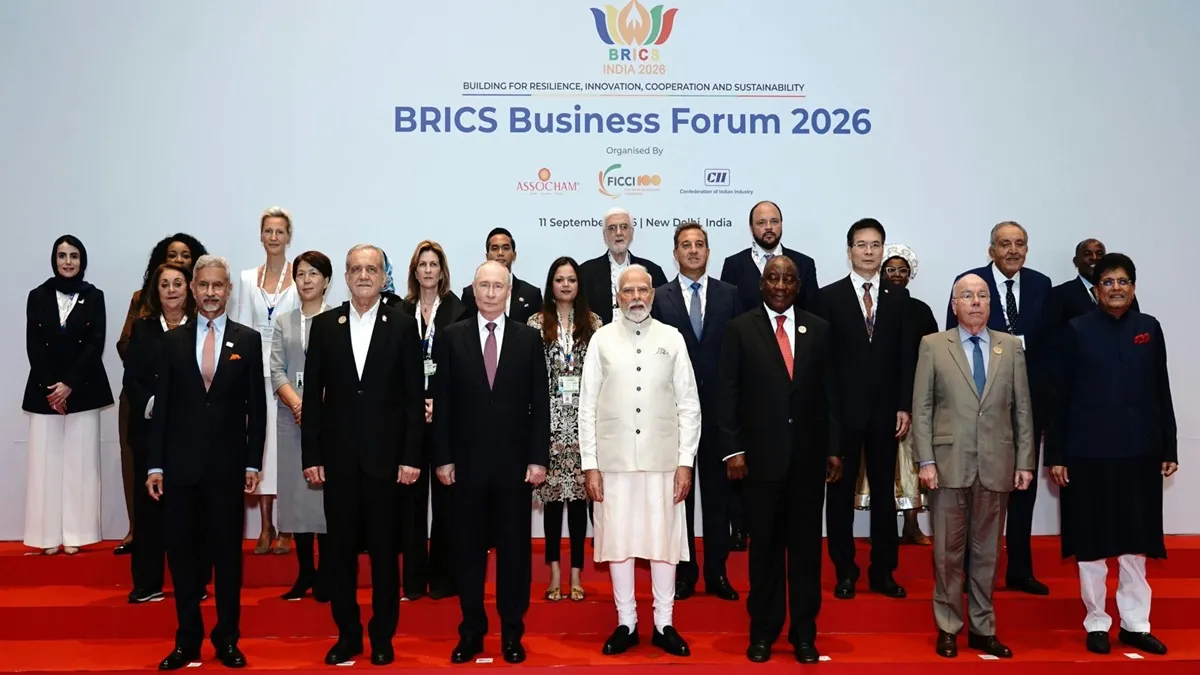
PM @narendramodi addressed the BRICS Business Forum, held in New Delhi today. President Putin of Russia, President Pezeshkian of Iran, President Ramaphosa of South Africa and Foreign Minister Vieira of Brazil also participated in the event.
— Randhir Jaiswal (@MEAIndia) September 11, 2026
PM highlighted that in the last 20… pic.twitter.com/kbMNRIbzKI
Brazil then joined, and RIC became BRIC. The first summit took place in Yekaterinburg, Russia, on June 16, 2009. Manmohan Singh, Hu Jintao, Dmitry Medvedev, and Lula da Silva came together on one platform.
The world was grappling with the financial crisis. At the same time, the G-20 was also taking shape. BRICS stated that it wanted to be the voice of emerging economies. When South Africa joined in 2010, the name became BRICS. Since then, meetings have been held annually.
Despite border disputes, trade conflicts, and strategic differences among member states, it ensured that no table remained empty at the summit. Over the years, Egypt, Ethiopia, Iran, the UAE, and Indonesia were added.
No Intention To Form Military Alliance
Meanwhile, the grouping did not establish a strict agenda or propose any military alliance. Discussions continued without any agenda, focusing solely on development banks, mutual trade, and reforming global institutions. Now, as global systems crumble and NATO's future is in serious question, BRICS has not disintegrated, but rather grown.
NATO Faces Existential Crisis In Trump Era, But BRICS Continues To Grow
Perhaps BRICS' greatest achievement is its transformation from a club of emerging economies to a significant platform for the collective voice of the Global South. Today, it has 11 members and 10 partner countries. There are a dozen other countries eager to become members. It has become the world's largest forum where the idea of a multipolar world is taking off, albeit at a somewhat slow pace.
With its current membership, the group represents nearly half the world's population and about 40 per cent of the global economy based on purchasing power parity. But the real story of BRICS is much bigger than these figures.
Its significance lies in the fact that the world's economies, which for a long time felt relatively underrepresented in decision-making power in global institutions, are now collectively demanding their place.
Many institutions of global governance, from the United Nations Security Council to the International Monetary Fund and the World Bank, were created at a time when the world's economic and political realities were quite different from today. BRICS has become a platform to challenge this imbalance.
It is also interesting that while not all BRICS members are unanimous on the question of confrontation with the West, they share a common view on the need for a more representative world order.
New Development Bank: A Major Success Of BRICS
The 2010s marked a major turning point in the BRICS journey. An agreement was reached in 2014 to establish the New Development Bank, which came into force in 2015. Its mission was to provide financing for infrastructure and sustainable development in developing and emerging economies. Today, it is one of the most substantial institutional outcomes of BRICS. The New Development Bank (NDB) is not merely an alternative bank. Its significance lies in the idea that developed countries should not be the dominant force in determining capital for development. India also receives significant funds from the NDB for its development projects.
Over the period of time, the bank has also moved towards financing in currencies other than the dollar. BRICS discussions on increasing trade and payments in local currencies have become part of this broader process. While it has been clarified that BRICS does not aim to create an alternative to the dollar, the organisation also rules out the possibility of introducing a common BRICS currency in the near future; many experts consider this approach more practical.
The world can only be freed from dependence on a single currency and a single financial centre gradually. Some believe this is perhaps the BRICS' greatest economic ambition.
The Real Test Is Yet To Come
The story of BRICS is not just one of achievements. It also harbours deep contradictions, and this poses the biggest question for its future. Border disputes and strategic competition exist between China and India. The conflict between Russia and the West has divided global politics. There are strategic differences between Iran and some Gulf countries. There are significant trade imbalances among many BRICS countries. China's economic power far outweighs that of most other members, raising concerns that it would be a mistake to consider it a unified political or economic union. It lacks a common treaty, a shared budget, or a permanent secretariat like the European Union.
Everyone fears that BRICS could gradually drift toward a China-centric system. It encompasses both democratic and authoritarian political systems. Some have resource-based economies, while others are manufacturing-based. Some have vast domestic markets, while others rely on energy exports. Their foreign policy interests are also not always aligned. Many now question the usefulness of BRICS, but many, including India and other member countries, believe it is essential for global balance.
(With Jagran.com Inputs)
You May Also Like To Watch