
- India rejects UN expert's claims on youth mental health, gender justice.
- Cites unverified, anonymous submissions in Special Rapporteur's report.
- Highlights India's active diplomatic push and global engagement at UN.
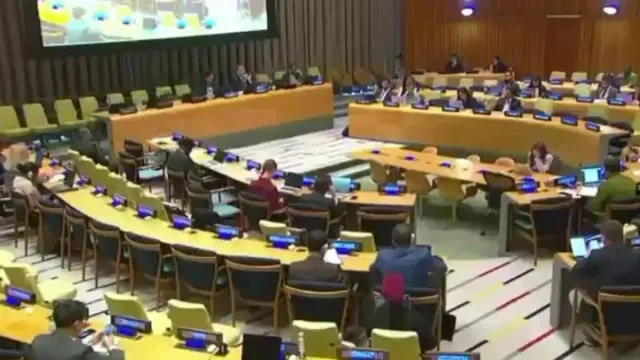
India on Friday (local time) rejected allegations by UN Special Rapporteur Gina Romero that young people in the country face retaliation or stigma for discussing mental health and gender justice. Speaking at the 81st session of the UN General Assembly’s Third Committee, First Secretary Anuj Swarup said the claims were based on anonymous and unverified submissions. India’s counter comes at a time when India has adopted an active diplomatic approach at the UN, raising issues ranging from global governance reform and international security to climate finance and human rights.
India Calls Out UN Expert's Report
In a post on X, the Permanent Mission of India to the United Nations stated that Swarup responded to allegations, emphasising that India’s Constitution guarantees freedom of peaceful assembly, association, speech and expression to every citizen. He also pointed to the government’s engagement with young people, action against examination fraud and reforms in competitive examinations.
#IndiaAtUN Anuj Swarup, First Secretary, delivered 🇮🇳’s statement at the 81st Session of the UNGA Third Committee in the Interactive Dialogue with the Special Rapporteur on the rights to freedom of peaceful assembly and of association, highlighting the following: ➡️ 🇮🇳’s constitution guarantees freedom of assembly, association, speech and expression to every citizen which are protected by an independent judiciary, a free press and an empowered National Human Rights Commission. ➡️ Youth engagement by the Government and swift actions taken against individuals engaged in exam fraud and systemic overhaul of competitive examinations. ➡️ Viksit Bharat Young Leaders Dialogue in which over five million young people shaped national priorities directly with the Prime Minister and continued direct engagement with youth. @PMOIndia @MEAIndia @IndianDiplomacy @PIB_India @airnewsalerts @DDNewslive @EduMinOfIndia @YASMinistry
— India at UN, NY (@IndiaUNNewYork) October 16, 2026
“Yet, the special rapporteur, Ms Gina Romero, asserts that young people in India face retaliation or stigmatisation for discussing mental health or gender justice, though mer citing unnamed submissions in the footnote. This level of arbitrary report writing is precisely the reason that the United Nations and its institutions have lost credibility,” Swarup said.
He added, “A sweeping charge against the world's largest youth population resting on anonymous and unverified claims is not evidence. It is hearsay, dressed up as a UN report, and my delegation rejects it outright.”
Recommended For You
India’s Wider Diplomatic Push At UN
The statement comes as India has adopted an active diplomatic approach at the United Nations in recent times. At different sessions of the UNGA, India has effectively raised issues ranging from global governance reform, terrorism, international security to climate finance and human rights. India has also intensified efforts in representing the concerns of developing countries and the wider Global South.
India’s voicing of the concerns becomes more significant considering the fact that India does not have a permanent seat on the UN Security Council (UNSC). Despite its long-standing demand for reform of the body, India remains out of the bloc and is currently pursuing a non-permanent seat. However, Indian diplomats and leaders effectively participate in UNGA debates of which it is a founding member, committee meetings and public statements to put the country’s positions on record and challenge claims it considers unfair.
From terrorism and regional conflicts to youth rights and climate finance, India has intervened and set the record straight in wide-ranging issues. Here’s a look at five recent instances of India’s diplomatic push at the UN.
1. Challenging OIC On Jammu and Kashmir
At the UNGA’s Sixth Committee meeting held in October, BJP MP Biplab Kumar Deb rejected remarks by Saudi Arabia on behalf of the Organisation of Islamic Cooperation (OIC). India defended its right to act against cross-border terrorism, while calling attention to human rights violations in Pakistan-occupied Jammu and Kashmir.
2. Voicing Concerns Over West Asia
India has also made its position clear on several global conflicts. It recently called for de-escalation and a negotiated two-state solution to the Israel-Palestine conflict. At the United Nations Security Council’s quarterly open debate held on Friday, India’s representative Parvathaneni Harish raised concerns over attacks on civilian infrastructure and commercial shipping routes in the Red Sea and Bab-el-Mandeb. India stressed the need to protect UNIFIL peacekeepers in Lebanon.
Delivered our National Statement at the #UNSC Open Debate on the Middle East. Made the following points: 🇮🇳 has high stakes in the region's security and stability, with 10 million Indians living in GCC countries. Called for restraint, immediate de-escalation, and resolution through dialogue and diplomacy. 🇸🇦 Strongly condemned attacks on civilian infrastructure, including Saudi airports, and conveyed solidarity with Saudi Arabia. ⚓ We also condemned attacks on commercial shipping. Attacks on merchant vessels and seafarers are legally and morally indefensible, and freedom of navigation must be upheld under international law. 🇮🇳🤝 🇱🇷 India and Liberia launched a Group of Friends on Safety and Security of Shipping and Seafarers, with 23 member states joining us. PM @narendramodi proposed a "Seafarers Emergency Support Network" at the BRICS Summit. 🇾🇪 On Yemen: unwavering support for unity, sovereignty and territorial integrity. Protecting Bab al-Mandab is a shared international responsibility. 🇵🇸 The focus on shipping must not divert attention from Gaza's humanitarian crisis. India condemned the 7 Oct 2023 attacks and supports a negotiated Two-State Solution, full implementation of UNSCR 2803, and continued development and humanitarian assistance. India has so far contributed over US$52 mn to UNRWA. 🇱🇧 On Lebanon : UN 🇺🇳 peacekeepers must never be targets. We condemned attacks on UNIFIL and urged preparation for a post-UNIFIL scenario. 🇸🇾 On Syria: a Syrian-led, Syrian-owned political process in line with UNSCR 2254. ☮️ Peace is not just the absence of war. India remains committed to a secure, stable and prosperous Middle East.
— Parvathaneni Harish (@AmbHarishP) October 15, 2026
3. Pressing For Climate Finance
Ahead of COP31, India has called for climate finance, technology transfer and capacity-building support for developing countries. During a special United Nations, Indian Counsellor Soumya Nair delivered India's official statement outlining the country's core environmental priorities.
4. Countering Pakistan On terrorism
At the UN, several Indian representatives have raised the Pahalgam attack, the 26/11 Mumbai attacks and 9/11 while accusing Pakistan of supporting terrorism. During a United Nations debate on international security held in October, Indian diplomats Raghoo Puri and Mahima Kumari Mewar strongly countered Pakistani delegates who tried to distract the forum.
5. Replying To Criticism Over Protest Detentions
India's permanent mission to the UN also strongly rejected criticism from Western lawmakers and the UN human rights office (OHCHR) regarding how police managed recent protests in New Delhi. On October 14, India formally urged UN human rights mechanisms to avoid politicisation and extreme selectivity.
You May Also Like To Watch: