
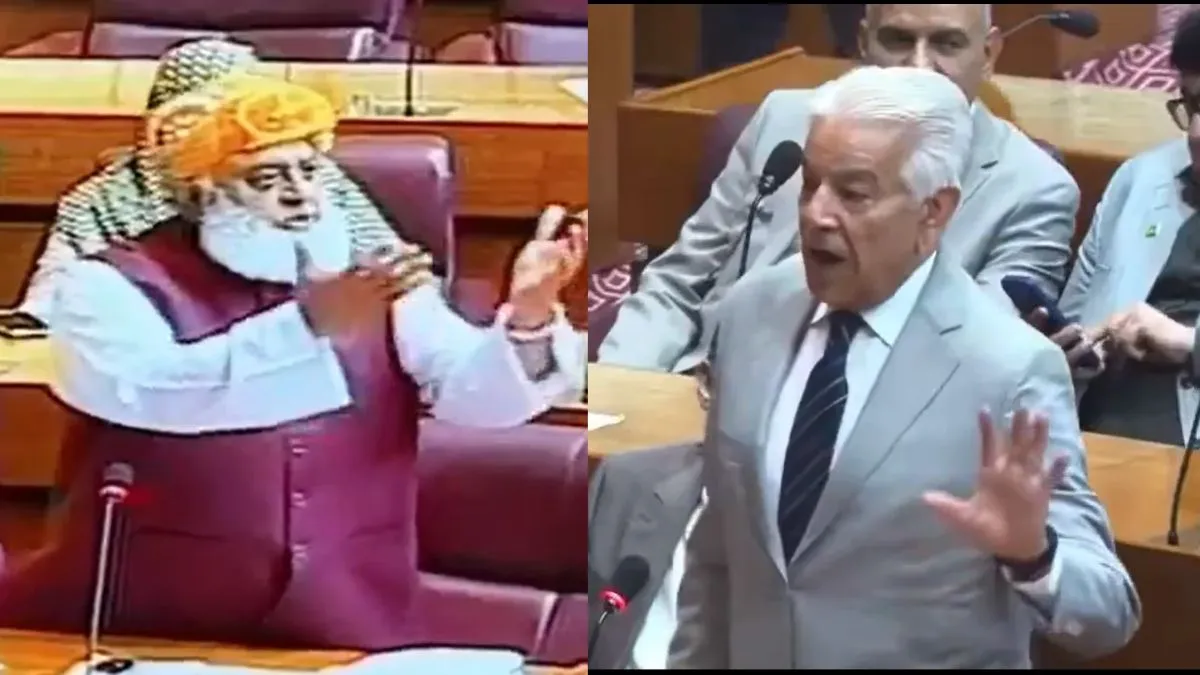
- Defence Minister Khawaja Asif criticised for Tehran meeting absence.
- Army Chief Asim Munir attended regional security talks in Iran.
- Incident sparks debate on Pakistan's civil-military roles.
Islamabad/New Delhi: Pakistan's Defence Minister Khawaja Asif faced sharp criticism in Parliament after Jamiat Ulema-e-Islam-Fazl (JUI-F) chief Maulana Fazlur Rehman questioned his absence from a high-level regional security meeting in Iran attended by Pakistan’s military chief, Field Marshal Asim Munir.
Addressing the National Assembly on Wednesday, Fazlur Rehman highlighted the apparent contrast between the defence minister’s presence in Parliament and Munir’s participation in discussions in Tehran involving senior regional officials.
“A defence pact is taking shape in Iran, a meeting is taking place there, and the defence minister is sitting here,” Rehman remarked, according to media reports. His comments prompted laughter and desk-thumping among lawmakers.
جناب خواجہ آصف صاحب بھی تشریف فرما ہیں۔ وزیرِ دفاع! دفاعی معاہدہ ایران میں ہو رہا ہے، میٹنگ ہو رہی ہے، دفاعی وزیر یہاں بیٹھا ہوا ہے، خارجہ وزیر یہاں بیٹھا ہوا ہے۔ وہاں بھی وزارتِ داخلہ کی ڈیوٹی ہوتی ہے؟ اپنی عزت و مقام، کوئی شرم ہوتی ہے، کوئی حیا ہوتی ہے۔امیر جےیوآئی کا قومی اسمبلی میں خطاب #مولاناکی_للکار #عوام_کاسامناکرو #سنسرڈ_پارلیمنٹ_نامنظور #حلف_سےوفاداری_نبھاؤ #جمھوریت_میں_زباں_بندی_کیوں
— Jamiat Ulama-e-Islam Pakistan (@juipakofficial) October 28, 2026
Fazlur Rehman turns Asif’s remark against him
Rehman also questioned why Pakistan’s Interior Minister Mohsin Naqvi had accompanied Munir to the meeting. His remarks then took a pointed turn as he used a phrase previously associated with Asif’s criticism of Pakistan Tehreek-e-Insaf (PTI).
“There is your respect and stature-- koi sharam hoti hai, koi haya hoti hai,” Rehman said, roughly translating to, “Have some shame, show some decency.”
The remark drew further amusement in the House and brought renewed attention to the political tensions surrounding Pakistan’s handling of regional security and diplomacy.
Khawaja Asif rejects criticism
Responding in Parliament on Thursday, Asif denied that a defence agreement was being negotiated during the Tehran meeting. He maintained that the discussions were not directly related to Pakistan’s defence ministry.
Over to you @juipakofficial and @MoulanaOfficial https://t.co/Hp5BL8vlgS
— Saqiiii (@Noctivagance_) October 29, 2026
Asif said Munir had taken on a role focused on promoting peace and dialogue in the region following the previous year’s military conflict with India.
The defence minister’s response came amid questions about the respective roles of Pakistan’s civilian government and military leadership in foreign policy and regional security matters.
Recommended For You
Regional security talks in Tehran
The meeting brought together Munir, Naqvi, Saudi Defence Minister Prince Khalid bin Salman, Turkish intelligence chief Ibrahim Kalin and senior Iranian officials.
The discussions focused on regional peace, security and cooperation. Following the talks, a joint statement indicated that the participating countries intended to continue dialogue on shared regional challenges.
Iranian President Masoud Pezeshkian also called for greater unity among regional nations, emphasising cooperation to address common concerns and withstand external pressure.
Civil-military roles under scrutiny
The parliamentary exchange has renewed debate over the division of responsibilities between Pakistan’s elected government and its military establishment, particularly when sensitive defence and diplomatic matters are involved.
While Fazlur Rehman questioned why the defence minister was absent from the Tehran discussions, Asif argued that the meeting did not fall within his ministry’s remit.
The episode has since drawn attention to the political dynamics surrounding Pakistan’s regional diplomacy and the prominent role played by its military leadership in security-related engagements.
You may also like to watch