
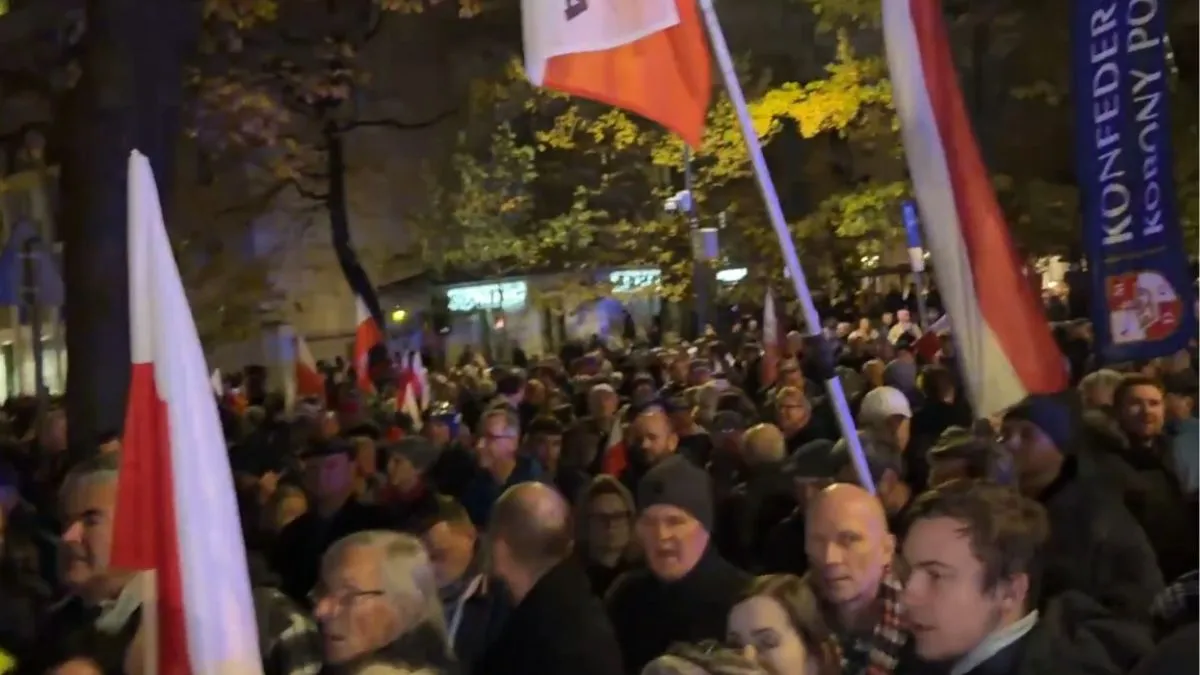
- Police entered Poland's Constitutional Tribunal in Warsaw.
- Suspension of top judges have sparked leadership dispute.
- President Nawrocki cut short trip and returned to Poland.
Poland Crisis: Poland was thrown into a fresh political and constitutional crisis overnight on Friday after a major dispute broke out over the leadership of the country’s Constitutional Tribunal. Police entered the court premises in Warsaw, while protesters gathered outside the building. The situation also forced President Karol Nawrocki to cancel his visit to Senegal and return to Poland during his journey. The turmoil has brought Prime Minister Donald Tusk’s government and the president into a direct confrontation.
What Triggered The Crisis?
The situation escalated after Constitutional Tribunal President Bogdan Swieczkowski and his deputy Bartłomiej Sochanski were suspended from their duties for one month. According to reports, Judge Anna Korwin-Piotrowska announced the suspension and claimed temporary control of the court. The move was strongly opposed by people linked to the right-wing Law and Justice (PiS) party, who described it as a coup against the country's judicial system.
⚠️🇵🇱 Poland’s constitutional crisis escalated overnight as police secured the Constitutional Tribunal in Warsaw and its contested leadership was suspended. President Karol Nawrocki aborted a trip to Senegal mid-flight and later entered the building amid scuffles. For years the external concern was pressure from Moscow. The confrontation that erupted was internal. A judge whose appointment Nawrocki refused to confirm—Anna Korwin-Piotrowska—announced the one-month suspension of Tribunal President Bogdan Święczkowski and his deputy, then claimed temporary control. PiS-aligned figures and the court’s own channels called it a coup d’état. Prime Minister Donald Tusk defended the steps as “restoring the rule of law,” describing the process after years of PiS influence as “difficult, sometimes painful” and requiring “decisive action.” Marcin Przydacz of the Presidential Chancellery accused the judges who blocked the entrance of violating the president’s physical integrity: “These are supposed to be judges? They are bandits who use violence.” Konfederacja and other opposition voices echoed the demand to keep hands off the president. Police presence was requested by the justice minister and the judge claiming authority, citing threats to staff and public disorder; protesters breached a fence and objects were thrown. The episode fits a wider European pattern in which “protecting democracy” has increasingly meant neutralizing opponents through institutions, courts, intelligence services, and electoral rules rather than leaving outcomes to voters. 🇷🇴 - Romania annulled a presidential election after Călin Georgescu finished first, then barred him from the rerun. 🇭🇺 - Hungary’s new government rewrote the constitution with retroactive term limits that permanently exclude Viktor Orbán from the premiership. 🇩🇪 - Germany’s domestic intelligence service classified the AfD as extremist, opening the door to heavier surveillance of the country’s largest opposition party. 🇫🇷 - France upheld Marine Le Pen’s conviction, maintained restrictions on her political future, and ordered her to wear an electronic ankle bracelet. 🇪🇸 - Spain has seen more than a dozen people linked to Pedro Sánchez’s political and personal circle investigated or prosecuted in separate cases, while Sánchez himself has not been charged. 🇬🇧 - Britain postponed local elections during a broad local-government reorganization, triggering petitions that accuse the government of voter suppression. And now Poland has police surrounding its Constitutional Tribunal while the government and opposition accuse each other of trying to seize the court. History has repeatedly treated institutional chaos in Poland as an early warning. The signal has rarely been good.
— 🔥🗞The Informant (@theinformant_x) October 31, 2026
The main dispute is connected to disagreements over judicial appointments. Nawrocki has reportedly refused to approve several judges selected by the current parliamentary majority. At the same time, Swieczkowski has also faced criticism for blocking some newly appointed judges from taking their positions.
Recommended For You
Police Enter Court Amid Protests
Police officers were sent to the Constitutional Tribunal after concerns were raised about the safety of judges and court employees. Videos that have emerged online show a huge crowd gathered outside the building to protest against the developments. Some protesters even crossed the fence and engaged in a brawl.
Amidst this chaos, Karol Nawrocki, the President of Poland, crossed a police barricade and entered the premises of the Constitutional Tribunal. https://t.co/K3qxMk0maU
— Paweł Rybicki (@Rybitzky) October 30, 2026
President's Mid-Air Return
President Nawrocki was travelling to Senegal when the crisis unfolded. However, he decided to cancel his visit and return to Warsaw, saying that the country's leadership needed to be present during such an important situation. After reaching Poland, he visited the Constitutional Tribunal building along with Supreme Court First President Zbigniew Kapinski.
Tusk Defends Government's Decision
Meanwhile, Prime Minister Donald Tusk has defended the government's actions. He argued that the steps were necessary to repair problems created during the previous PiS government. The developments come as his administration has promised to restore judicial independence and reverse controversial changes introduced between 2015 and 2023, when PiS was in power. Notably, Poland's Constitutional Tribunal decides whether laws passed by parliament follow the country's Constitution and its independence and membership have become major political issues in recent years.
ALSO READ: Rising Costs, Mounting Debt, Anger Against Macron: Why France Is Witnessing Nationwide Protests
You May Also Like To Watch: