
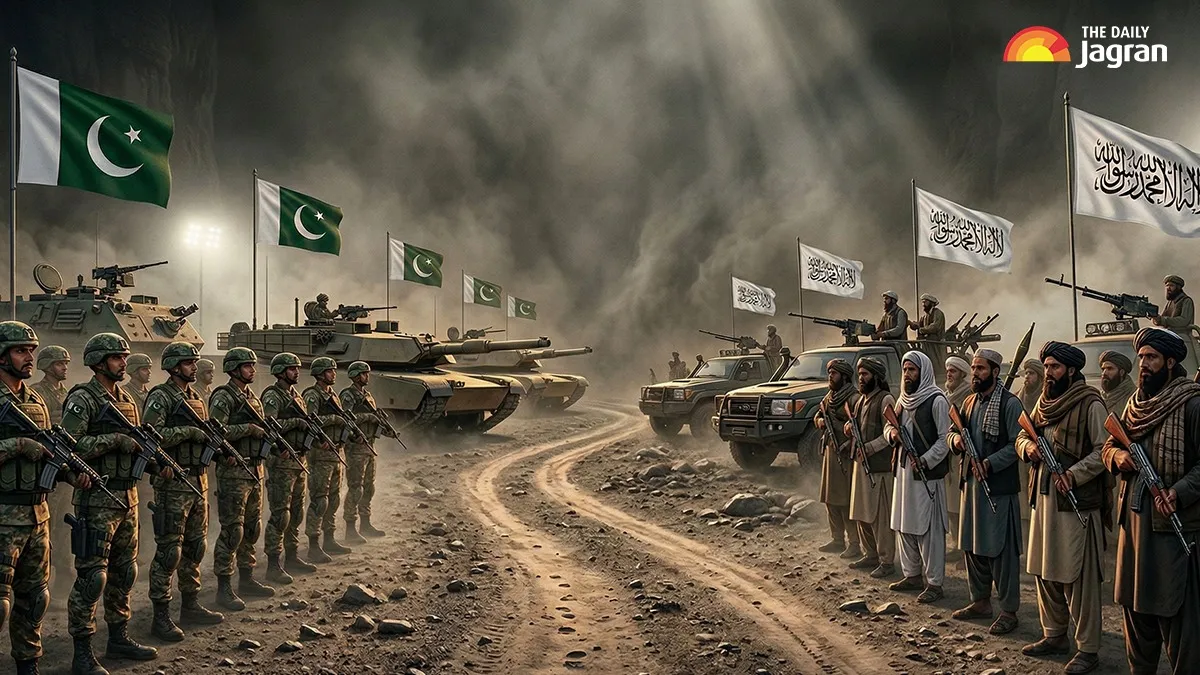
Pakistan-Afghanistan Tensions: Cross-border clashes between Pakistan and Afghanistan escalated overnight, with both nations reporting heavy casualties. Pakistan’s Defence Minister described the situation as an “open war” with its neighbouring country.
Pakistan initiated a retaliatory military action following alleged attacks by the Afghan Taliban along the border, claiming that more than 130 Taliban fighters were killed.
The operation, named 'Operation Ghazab lil Haq', began late Thursday night after the Afghan Taliban reportedly targeted several Pakistani border posts. Defence Minister Khawaja Asif confirmed that the offensive was in progress, stating that Pakistan’s armed forces were delivering a robust response to what he termed aggression by the Afghan Taliban.
Information Minister Attaullah Tarar said at least 133 Afghan Taliban operatives were killed and over 200 others were injured during the operation.
State broadcaster PTV News reported that the Pakistan Air Force carried out strikes on key Taliban military sites in Kabul, Kandahar, and Paktia. The report said two brigade headquarters in Kabul were destroyed, along with one corps headquarters and one brigade headquarters in Kandahar.
State-run broadcaster PTV News reported that the Pakistan Air Force struck key Taliban military installations in Kabul, Kandahar, and Paktia. According to the report, two brigade headquarters in Kabul were destroyed, along with one corps headquarters and one brigade headquarters in Kandahar.
Recommended For You
However, Afghanistan-based Tolo News reported that the Afghan army is responding to Pakistan’s offensive. It claimed that Afghan forces shot down a Pakistani F-16 fighter jet for allegedly violating Afghan airspace.
As tensions continue to rise, here is an overview of how Pakistan’s military strength compares with that of Afghanistan.
Pakistan-Afghanistan Tensions: Who is stronger in Pakistan-Afghanistan?
The escalating conflict has created a war-like environment between the two countries, raising questions over which side holds the upper hand in terms of military strength.
According to a report by Jagran.com, Pakistan has around 660,000 active military personnel. With reserves included, that number could rise to nearly 1.7 million. In comparison, the Afghan army has between 165,000 and 172,000 active troops, with reserve forces bringing the total close to 200,000. This means Pakistan has roughly four times the number of active troops compared to the Taliban.
If the situation were to escalate into a full-scale war, Pakistan’s conventional military advantage including superior troop strength, air power, and artillery could prove decisive. However, Taliban fighters, known for asymmetric and guerrilla warfare tactics, could still pose serious operational challenges.
Pakistan vs Afghanistan: Who has how many weapons?
Pakistan is estimated to have 2,677 tanks, whereas the Afghan army possesses between 100 and 200 tanks, many reportedly in poor working condition.
The Pakistani military operates over 59,000 armored vehicles and more than 6,000 armored fighting vehicles (AFVs). In contrast, the Taliban reportedly have a limited number of Humvees left behind by US forces during their withdrawal.
Pakistan fields approximately 4,600 artillery units, while the Taliban are believed to have only a few hundred.
In terms of air strength, Pakistan has around 1,399 aircraft, including more than 400 fighter jets. On the other hand, the Afghan side has about nine older fixed-wing aircraft and 23 helicopters, putting it at a clear disadvantage in aerial combat capability.