
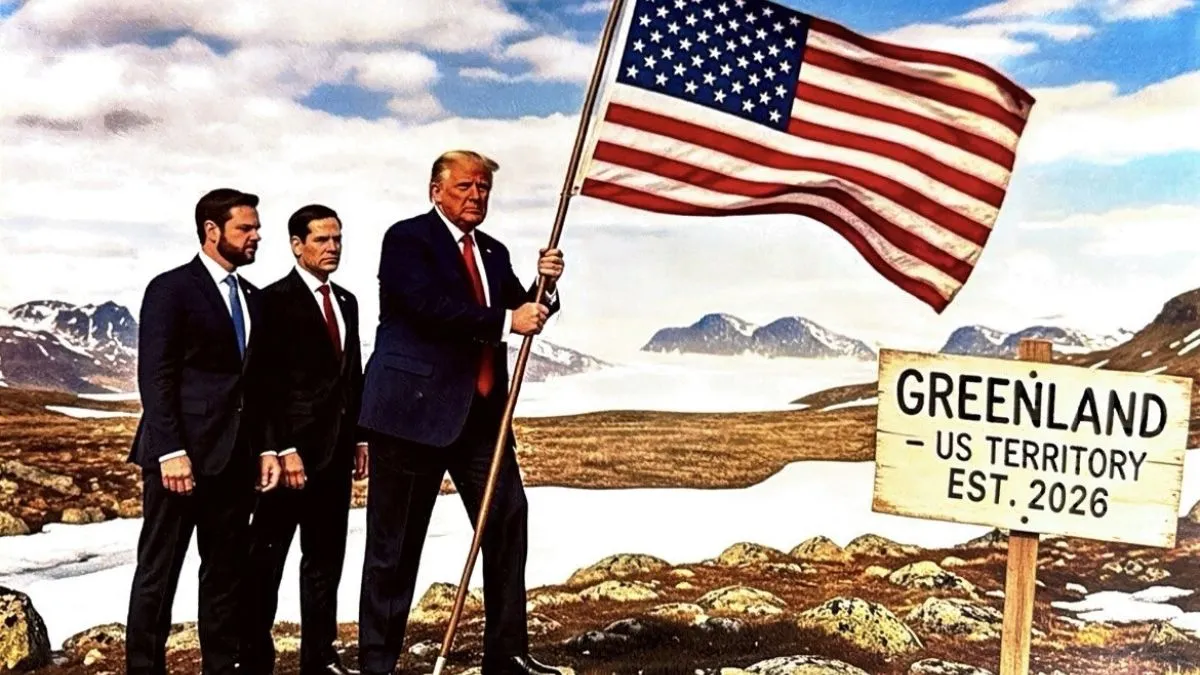
- Trump abandoned military force and tariff threats for Greenland.
- Claimed deal framework with NATO chief for Arctic region.
- White House aides urged caution on aggressive acquisition tactics.
US President Donald Trump's retreat from threats of force as an option for acquiring Greenland capped weeks of policy chaos, as top aides scrambled both to accommodate the president's demands and ease the panic they caused among US allies, news agency Reuters reported, citing two sources with knowledge of the conversations.
In remarks on Wednesday at the World Economic Forum in Davos, Switzerland, Trump ruled out using military force after weeks of refusing to do so, and in a social media post said he would no longer be imposing tariffs that he had threatened to put into effect on February 1.
Why Trump takes a step back on Greenland
White House officials had pushed a less provocative approach, with several key members of the president's team unenthusiastic about possibly using military force to seize the Danish territory, Reuters quoted two White House sources. They spoke on condition of anonymity to discuss internal deliberations.
Recommended For You
ALSO READ: Trump Takes Sharp U-Turn Over Greenland, Rules Out Military Action; What's Next?
Trump claims US has reached a deal with NATO chief
After saying on Wednesday that tariffs are off the table, Trump said he and NATO Secretary General Mark Rutte had "formed the framework of a future deal with respect to Greenland and, in fact, the entire Arctic Region" during talks in Davos. He tasked top officials with negotiating a potential deal.
The episode underscored how Trump's long-running fascination with acquiring Greenland keeps crashing into diplomatic and political reality, emblematic of a second term defined by abrupt policy shifts and rapid reversals. Again and again, the Republican president has changed course on tariffs and other issues under economic, political or market pressure.
Asked about Trump's aides not pursuing military options seriously on Greenland, White House spokeswoman Anna Kelly said: "The White House does not rule out options for President Trump unless he does so himself." "He announced today that he will not use force to take Greenland, and the entire administration will follow his lead," Kelly said, adding that if a deal is reached, the United States would achieve its goals in Greenland at minimal long-term cost.
Trump’s Arctic ambitions rejected
In recent weeks, Trump has revived his long-standing ambition to acquire the Arctic island, arguing that it is vital to US national security as great-power competition intensifies in the Arctic. The leaders of Greenland and Denmark, which oversees the territory, have rejected Trump's overtures, stressing that the island's future is for its people to decide and accusing the United States of bullying tactics.
In a social media post on Saturday, Trump said he would implement a wave of increasing tariffs on European allies until the US was allowed to buy Greenland, which major EU states decried as blackmail.
Who proposed the bullshit idea of imposing tariffs?
The idea to use tariffs came from Commerce Secretary Howard Lutnick and other cabinet members, Reuters quoted the White House sources. However, a formal response from Lutnick is still awaited. The threats in Trump's post came after some European countries sent small numbers of military personnel to Greenland, ostensibly to show that they took US warnings about the island's security seriously.
Ahead of the Davos summit, European leaders stepped up their pushback against the US acquiring Greenland. "He doesn't like being cornered," said one of the White House sources, explaining Trump's tariff threat. That announcement set off a scramble in the White House to develop a tariff plan and understand how it would play out. Different agencies are still working out the "cycle of retaliation and counter-retaliation with tariffs" on EU members, the White House source said.
Tariff threat catches aides off-guard
Trump first floated the idea of taking over Greenland in 2019 but ramped up rhetoric after returning to power a year ago. In meetings last year, US officials assured their Danish counterparts that relations were stabilizing, leaving them with the impression that any military takeover of the Arctic territory was no longer top of mind for the administration, according to two separate sources familiar with those discussions.
That changed in December, when Trump abruptly announced that Louisiana Governor Jeff Landry would serve as special envoy to Greenland and renewed his push to acquire the territory, seemingly emboldened by the successful January 3 operation to capture Venezuelan leader Nicolas Maduro.
ALSO READ: Jagran Opinion: From Iran To Greenland, Trump's Revisionist World Order
While aides were broadly aligned on the goal of taking over Greenland, they were split over the president's aggressive approach, the two White House sources said. In most White House meetings, more officials have urged caution than those pushing for the United States to take the island by force, said the sources, who were unaware of serious discussions on military options to seize Greenland. Tom Dans, appointed by Trump to lead the US Arctic Research Commission, along with Vice President JD Vance and Secretary of State Marco Rubio, had been "pushing for a middle ground" on Greenland, while White House Deputy Chief of Staff Stephen Miller showed a willingness to keep annexation and the potential use of military force on the table, the sources said.
(With inputs from Reuters)