
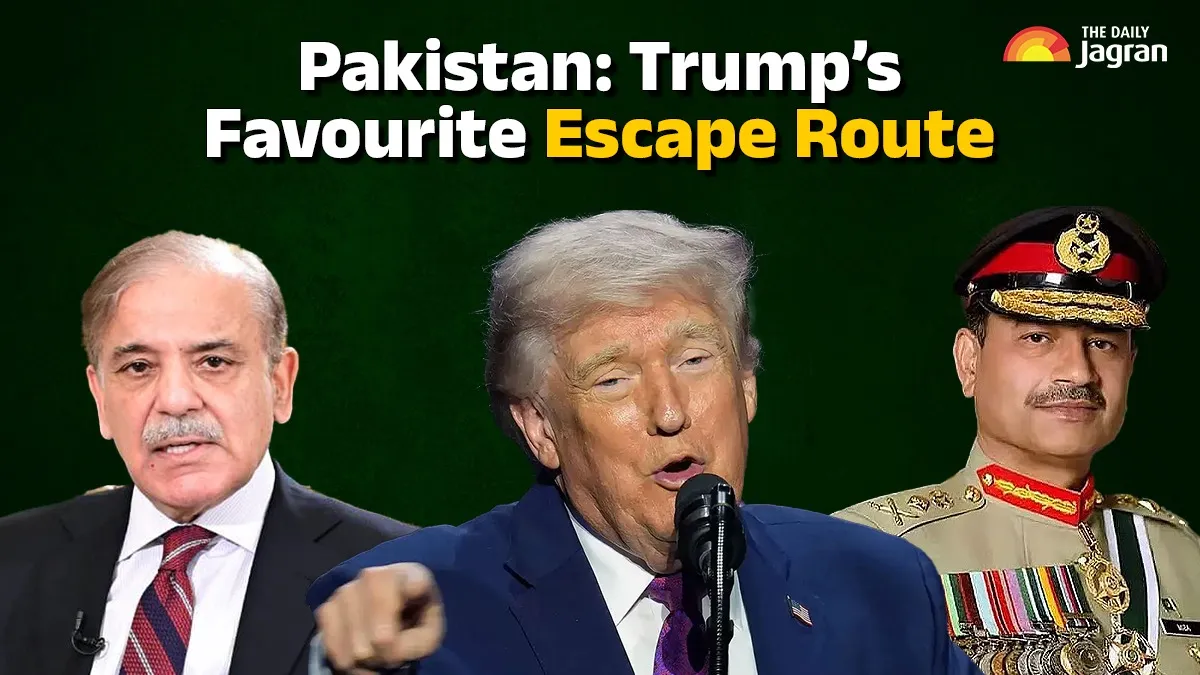
- Trump extends Iran ceasefire citing Pakistan's mediation.
- Pakistan used to frame policy shifts, avoid weakness.
- Narrative tool to deflect accountability, mask missteps.
US President Donald Trump said he would indefinitely extend the ceasefire with Iran to allow for further peace talks, although it was not clear on Wednesday if Iran or Israel, the US ally in the two-month war, would agree. Trump said in a statement on social media the US had agreed to a request by Pakistani mediators "to hold our Attack on the Country of Iran until such time as their leaders and representatives can come up with a unified proposal ... and discussions are concluded, one way or the other." The script reminds the same lyrics when Trump had announced Pakistan Prime Minister and their Army chief requested a ceasefire on April 8.
Why does Trump's script always look the same?
Why Pakistan become an easy scapegoat for the US President
1. Trump steps back from escalation, like delaying strikes or extending a ceasefire, he rarely presents it as his own recalculation. Instead, he frames it as a response to requests from Pakistan. This matters politically. A direct U-turn could be seen as weakness, especially after strong rhetoric. But if the same decision is shown as "responding to an ally," it looks like leadership and flexibility. In short, Pakistan is not just a mediator, it becomes a strategic narrative tool in how Trump communicates shifts in policy.

2. Creating a diplomatic cover for reversals
Pakistan's role as a mediator between the US and Iran gives Trump a ready-made explanation for policy shifts. He escalates tensions, threatens Iran and project Islamabad as a mediator. Swiftly, if Iran does not agrees or show some deterrence, Trump flips and give credit to his "favourite" Pakistan Field Marshal Asim Munir and Prime Minister Shehbaz Sharif. This always help Trump in building a narrative shield. Instead of saying "we changed course," the messaging becomes "diplomacy worked." It reframes inconsistency as negotiation success.
Recommended For You
3. Inflating Pakistan's influence to mask US missteps
In reality, major geopolitical decisions are still driven by Washington. But Trump often publicly amplifies Pakistan’s role, crediting its leadership or military for breakthroughs. This has two effects:
-It diverts attention from any flawed US strategy.
-It creates an impression that outcomes are the result of shared diplomacy, not unilateral decisions.
-Essentially, Pakistan’s role is sometimes magnified to dilute scrutiny on US actions.
4. Using Pakistan as a buffer between rhetoric and reality
Trump's style is to start with maximalist rhetoric, threats, ultimatums, or dramatic warnings. But real-world constraints such as military, economic, diplomatic often force moderation. That’s where Pakistan comes in. By positioning it as an intermediary. The shift from aggression to restraint appears gradual, The gap between what was said and what is done becomes less visible. Pakistan, on the other hand, acts as a shock absorber between bold statements and practical outcomes.
ALSO READ: Trump Flips Again, Extends Iran Ceasefire Amid Ongoing Blame Game: What We Know So Far
5. Deflecting accountability amid pressure
When policies don't deliver quick results, like prolonged conflict or failed talks, accountability becomes politically risky. By inserting multiple actors into the narrative Pakistan, US officials, allies, responsibility becomes diffused- Was it a US miscalculation? Or did mediation fail? Or did partners complicate things? This layered narrative ensures no single actor, especially Trump, takes full blame.
(With inputs from agency)
You may also like to watch